| 
     
     
Introducing the newest Donald O'Connor Web
Site
Donald
O'Connor
in Context
 Click above to read Peggy
Ryan's
Click above to read Peggy
Ryan's
"Elegy for Donald" |
Click above for a tribute to
Peggy Ryan |
|
The Donald O'Connor
Web Site Update
Last Update 9/2/06
Excerpt from The
Tucson Citizen
'Singing In the Rain' star's estate to
go on sale
TERRY TANG
The Associated Press
6/28/2006
PHOENIX - As he demonstrated
in the classic film "Singing In the
Rain," entertainer Donald O'Connor
could wipe the floor - and a few walls
- with his dance skills.
Starting Friday, fans can
walk O'Connor's floors and have a chance
to buy a pair of his tap shoes at a three-day
estate sale his family is holding at the
late actor's home in the Village of Oak
Creek, outside of Sedona.
Just don't refer to his
possessions as stuff.
"My husband didn't
own stuff," Gloria, O'Connor's widow,
said in a phone interview from the Village
of Oak Creek. "He had wonderful,
beautiful things."
Among O'Connor's possessions
up for sale are a $30,000 Rolls Royce,
a baby grand piano, more than 25 pairs
of tap shoes and the vest he wore in the
movie "Anything Goes."
Oil paintings and dolls
belonging to actress Joan Crawford, whose
house O'Connor purchased in the '60s,
are also up for grabs.
Full
Article
I received an
email from authors Scott and Jan
MacGillivray of Massachusetts, whose
biography of Gloria Jean has just
been published, entitled Gloria
Jean: A Little Bit of Heaven.
"We thought
you and your fellow Donald O'Connor
admirers might be especially interested
in knowing about this," they
wrote. "Because (as you might
imagine) Mr. O'Connor figures quite
prominently in the book. There are
numerous first-person recollections
by Gloria, as well as a number of
photographs, which we think Donald's
fans will enjoy."
The book is available
in both paperback and hardcover
editions:
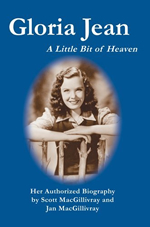
Gloria Jean: A Little
Bit of Heaven (Hardcover)
Paperback
|
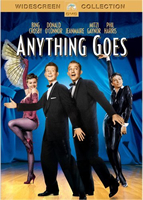
Anything Goes
The DVD Anything
Goes was released in September
2005. The story is nothing to dance
about in this 1956 film, but Donald
O'Connor gets a few opportunities
to shine, particularly in a duet
with Mitzi Gaynor to It's DeLovely.
It's well worth sitting through
the clunky plot.
|
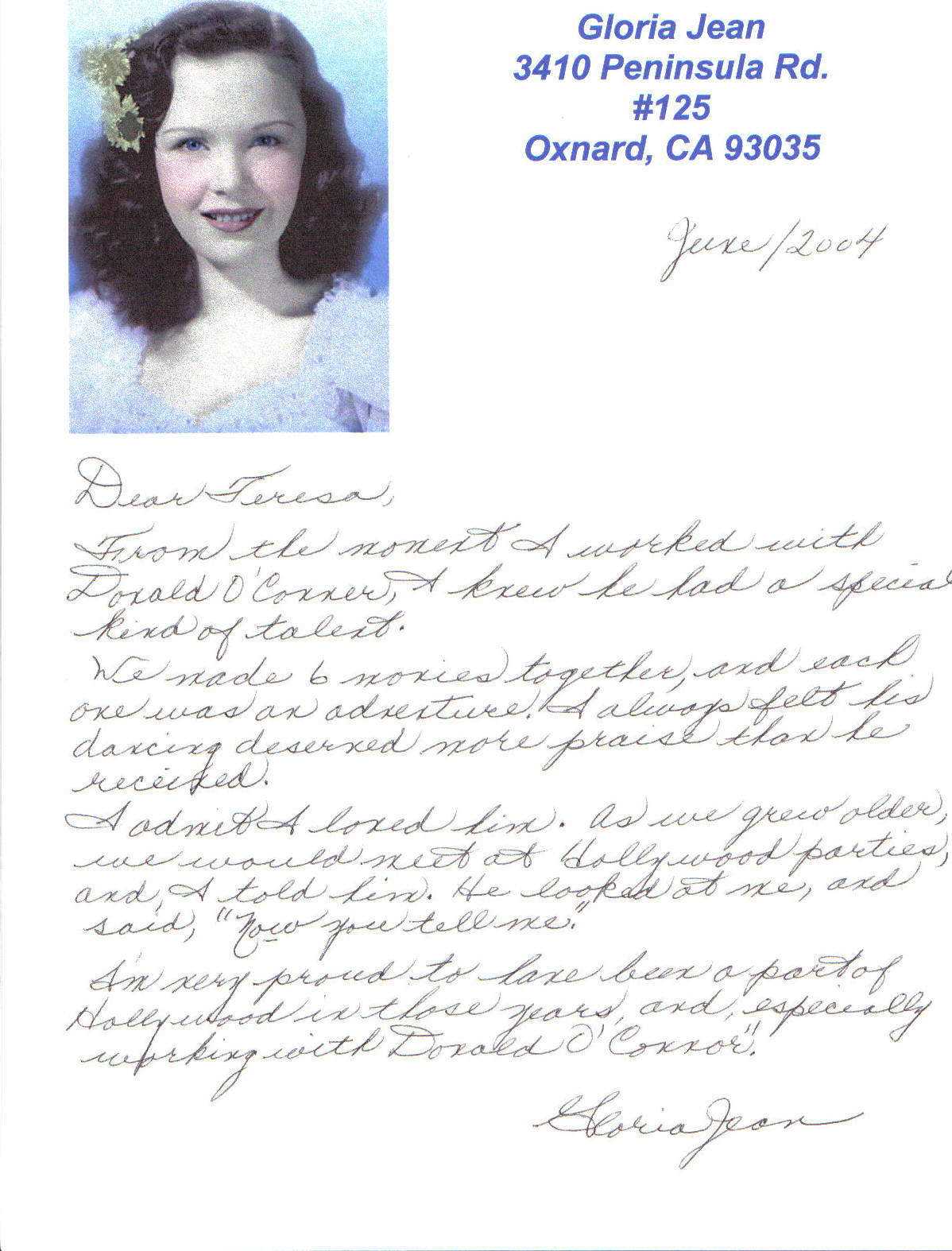
| Child/Teen star
Gloria Jean sent me a very charming
note last year about her friendship
with Donald O'Connor — |
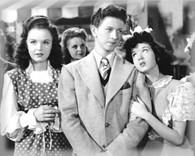
Gloria Jean, Donald
O'Connor and Peggy Ryan in What's
Cookin'
|
Dear Teresa,
From the moment I worked with Donald
O'Connor, I knew he had a special
kind of talent. We made six movies
together and each one was an adventure.
I always thought his dancing deserved
more praise than he received.
I admit I loved him. As we grew
older we would meet at Hollywood
parties, and I told him. He looked
at me and said, "Now you tell
me."
I'm very proud
to have been a part of Hollywood
in those years and especially working
with Donald O'Connor.
Gloria Jean
|
|
Gloria Jean
has a delightful website.
The site has a filmograhy, photo
gallery and articles. Also on the
site are CD, photos (like the one
above) and VHS movies for sale,
including five of the six she made
with Donald. As far as I know these
films are not available elsewhere.
You can order them from her here
for $24.95 per film plus shipping.
Gloria Jean-Donald
O'Connor Films
What's Cookin'
(1942)
When Johnny Comes Marching Home
(1942)
Get Hep to Love (1942)
It Comes Up Love (1942)
Mister Big (1943)
Follow the Boys (1944)
www.gloriajeanchildstar.com
|
|
I'd like to
thank the Academy...
For ending their
2004 Tribute Presentation with Donald
O'Connor. In a year when we lost
so many great performers, Donald
was given a place of honor. It's
not the Lifetime Achievement Award,
but it was nice all the same.
If you'd still
like to suggest that the academy
give Donald O'Connor the Lifetime
Achievement Award you may write,
phone, fax or email them at:
Academy of Motion Picture Arts and
Sciences
Academy Foundation
8949 Wilshire Boulevard Beverly
Hills, CA 90211-1972
Phone: 310-247-3000
Fax: 310-859-9351 or 310-859-9619
E-mail: ampas@oscars.org
To make a similar
request of the American Film Institute
write to:
AFI
2021 N. Western Avenue
Los Angeles, CA 90027-1657
323-856-7600
323-467-4578 Fax
The American Film Institute did
choose two of the songs which Donald
performed in Singin' in the Rain
for their
AFI's 100 Years... 100 Songs List
released June 1st. "Make 'Em
Laugh" and "Good Mornin'"
were voted 49th and 72nd respectively.
In July 2004
Donald O'Connor was also inducted
into the Tap Dance Hall of Fame
along with now deceased fellow tappers
Ann Miller and Gregory Hines.
|
|
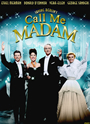
Great news for
Donald O'Connor fans! Call Me
Madam (1953), never before released
in any format, is now available
on DVD. This was truly a lost treasure:
a wonderful musical, political satire
and gentle romance. One of Donald's
best film and one of the few screen
appearances of Ethel Merman. And
no, the romance isn't with Ethel.
It's with the lighter than air Vera-Ellen.
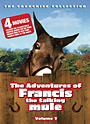
And even more great news! The first
four Francis the Talking Mule
films have been released on DVD.
That's Francis, Francis
Goes to the Races, Francis
Goes to West Point and my personal
favorite Francis Covers the Big
Town. All classics and all on
one DVD. You can order The Adventures
of Francis the Talking Mule Volume
I (Isn't that great? That means
they'll have a Volume II!) and/or
order Call Me Madam from Amazon.com.
Just click on the links below.
|
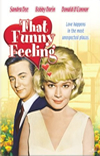
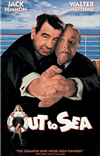
It never rains,
but it pour. Two more Donald O'Connor
films were released on DVD last
summer. The first was Donald's final
film Out to Sea (1997)
released June 1st and the second
was the frothy Bobby Darin/Sandra
Dee concoction That Funny Feeling
(1965) which came out on August
3rd, 2004. That's Entertainment
(1974) was released on DVD in October
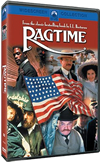
2004 and Ragtime (1981)
was released on November
16th 2004. Donald has little more
than cameos in both films, but they're
well worth getting in any case.
|
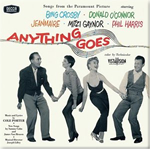
| Recently
released and available now is the
soundtrack (sort of) for Donald's
1956 film Anything Goes with
Bing Crosby. Some cuts are actually
studio tracks. "You're the Top",
for instance, which Donald partly
sings in the film, is a studio version
featuring only Crosby and Mitzi Gaynor.
You can buy it from Amazon by clicking
on the album cover to the right. |
|
|
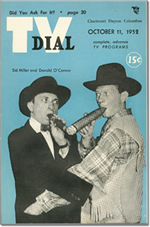
Sidney
Miller, Donald O'Connor's longtime
writing and comedy partner, died Jan.
10 2004 in Los Angeles after a two-year
bout with Parkinson's disease. He
was 87.
Miller
co-starred in eight Donald O'Connor
films and in the songwriter sketches
they performed on "Colgate Comedy
Hour" and the "The Donald
O'Connor Show."
Miller
appeared in more than 100 motion pictures
from the time he became a contract
actor at MGM, where he first appeared
in two Mickey Rooney movies, "Boys
Town" and "Men of Boys Town."
His
career as a television director included
such shows as "Get Smart,"
"Bewitched," "The Monkees,"
"That Girl," "The Addams
Family," "My Favorite Martian,"
"McHale's Navy," "Bachelor
Father" and "Celebrity Playhouse."
|
|
David
“Tom” Stern III, author of the
novel “Francis, the Talking Mule”
which inspired the Universal film series
starring Donald O'Connor, died Saturday
November 22nd 2003 in San Francisco. He
was 94.
On October
27th 2003 Donald received a posthumous award
for his outstanding contributions to dance
at “Gotta Dance! A Dance Tribute to
Hollywood,” presented by Career Transition
for Dancers at its ninth annual gala. The
award was announced by Arlene Dahl and sent
to his family. Also honored were Cyd Charisse
and Fayard Nicholas.
I'm
very saddened to report that Donald O'Connor
passed away Saturday September 27th, 2003.
![[cosmo site]](graphics/cosmopage.jpg)
Please check out this new
Donald O'Connor website featuring
Fan Fiction, a Discussion Board and
an Audio Interview.
|
|
|
  
| "I'm an illusionist - a
trickster who quick-changes before
your eyes. I capture your attention
without giving you time to think
about it. I move fast, I keep changing
my hats. And the more pleased an
audience is, the more energy I get
from it and give back to the audience."
- Donald O'Connor 1992
*
Born in
a Trunk
"I was born in a trunk... Judy
Garland's using it now." - 1964
1
.Donald
David Dixon Ronald O'Connor was
born -in a hospital- in Chicago
on August 28th 1925. He was the
seventh child (three of whom died
in infancy) of John Edward "Chuck"
O'Connor and Effie Irene Crane O'Connor,
circus performers who had graduated
into vaudeville. "My mother and
father met while they were working
in the circus. My mother was a trapeze
performer," 2
said Donald. "When she and Dad got
married, she was only 15. Dad was
much older, about 28. They formed
their own act, which they called,
'The Nelson Comiques' for a while.
I think they switched to Nelson
because they owed a hotel bill.
|
| "My father started
out as a circus 'leaper'. He'd run
down a ramp, jump over an elephant
and land on a mat. 3
He was a singer, a dancer, an acrobat,
a trapeze artist, a clown, a comedian,
and also a strong man.
4 He did a little bit
of everything, because the more you
did the more you made,"
5 explained Donald.
"He was 5'5" and weighed 220 pounds.
He was very light on his feet, though:
he was known as the Njinsky of acrobats.
The height he could get was incredible.
6 |
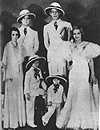
The
O'Connor Family
|
"By the time I came along, my mother
and father had left the circus and
were in vaudeville. They called the
act The O'Connor Family - Royal Family
of Vaudeville," 7
recalled Donald. "There was singing,
dancing, comedy, acrobatics and barrel
jumping in the act. 8
My father was glad I was born. With
each kid the O'Connor family act made
more dough. As soon as we could walk,
we went to work, adding another $25
a week to the family income."
9
.......
At three days old Donald O'Connor
made his first stage appearance. "After
I was born, my mother played the piano
in the act before going back to the
heavy dancing and that kind of stuff,"
10 said Donald. "I was
next to mother on the piano bench,
because it was the safest place for
me."11
.......
At 13 months old Donald started earning
his $25 a week. "The first thing I
did was dance and do acrobatic tricks."
He explained: "There are little tricks
you can do. You can hold a kid up
in your hand, and he'll try to keep
his balance. You put music to that
and it looks like an act."
12 [Note: Please, don't
try this at home] "I started out doing
the Black Bottom. 13
My mother had to grab me before I
fell down," he said. "I didn't want
to stop." 14
.......
Shortly after Donald made his professional
debut, the O'Connor family was shaken
by tragedy. "My sister [Arlene] and
I were hit by an automobile when I
was 13 months old, and she was six.
She was killed." While still reeling
from the loss, the family suffered
another stunning blow. "My father
dropped dead on stage thirteen weeks
later," 15
[from a heart attack, at the age of
47]. The father he would never know
remained an influence in Donald's
life. "My father could do everything,
and so I grew up with this phantom
character, hearing all these stories
about all the things he could do,
and so I tried to emulate him."
16
.......
Despite his father's sudden death,
The O'Connor Family act carried on
"Eventually the act was built up again
to include my mother, my two brothers
[Jack and Billy] and my sister-in-law.
She was a hell of a dancer, real great.
She married my oldest brother, Jack.
They had a baby daughter, Patsy, and
she went in the act. So that brought
us back to six again."
17
.......
Vaudeville was home to young Donald.
"I was born into it. There was never
anything else. 18
When you're a kid who likes to show
off, be precocious, get applause and
laughter, what could be better?"
19 asked Donald. "I
grew up in vaudeville, and never really
missed other kids because I was never
around them. I was treated like a
little adult, a working person.
20 |
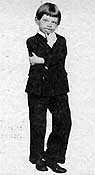
Donald...
with bangs |
"Everybody thought I
was going to be a midget," said Donald.
"I wore bangs and curls and was very
small. I'd come out onstage to 'Hail
Hail the Gang's all Here' in a suit
that made me look like a little old
man. I'd keep strutting right out
towards the audience till my brother
Billy caught me by the coat tails
and swung me back on stage. Then we'd
go into some acrobatics.
21 At the age of four
I was singing and closing the show
with 'Keep Your Sunny Side Up.' It
was my big number," 22
he remembered. "You learned to be
great real fast. You went out there
and caught the audience's attention
in the first 25 seconds or you ruined
it for the family. If you heard laughter
you knew it was working."
23 |
For Donald dancing was a part of
the act and a part of growing up.
"I don't remember who taught me my
first routine. I was just too young.
I never paid any attention, I guess,
because it was second nature for me
to pick up something and do the act.
I do remember though, getting together
with other dancers in drug stores
or on street corners and learning
new dancing routines.
24
.......
"It was a great time for me,
a time of wonderful memories. We traveled
the country and worked with all of
the big names of the period. George
Burns and Gracie Allen were just getting
started then. And I used to love working
with the Marx Brothers," recalled
Donald.
"After they entered motion
pictures they would go on the vaudeville
circuits and try out new material,
keeping the best stuff for their movies.
The Three Stooges did that, too.
25
"From backstage I watched
them all, the greats of the business:
Abbott and Costello, Olsen and Johnson,
Jimmy Durante, Jack Benny, Al Jolson,
Thurston, tops in their fields. I
loved magic. I loved magicians. I
just loved being a part of show business.
It was wonderful," Donald said. "We
did two shows a day and we worked
52 weeks a year on the old Fanchon
and Marco Circuit. We traveled everywhere
by train. I was such a happy kid.
All of this came naturally to me:
the singing, the dancing, everything."
26
Of course Donald prefers to
dwell on the more pleasant aspects
of his childhood, but there were hardships.
The hey-day of vaudeville had passed
and the depression was in full swing.
Donald remembered his family performing
in theaters where people slept because
they had nowhere else to go.
27 During the thirties,
The O'Connor's sometimes had to scramble
for engagements, which paid less,
and they struggled to make ends meet.
.......
No matter what the hardship, "the-show-must-go-on"
mentality prevailed for young Donald.
He remembered being accidentally injured
during one performance. His brother
Billy missed catching Donald by the
coattails as he leaned out over the
footlights. "He grabbed me by my left
ear and swung me back over before
I hit the orchestra pit," said Donald.
"My ear was bleeding. My white suit
was a mess, and I was crying like
mad. But I still kept singing 'Keep
Your Sunny Side Up'.
.......
In Chicago he slipped off a wall while
playing between shows. "I didn't tell
anybody, but went on and did my handstands
as usual," he recalled. "I got sicker
and sicker. Finally, after the fourth
show, my mother took me to a hospital
where they told me I'd been balancing
on a broken arm." 28
.......
Effie O'Connor had become intensely
protective of her remaining children,
particularly her youngest son, seeming
never to completely recover from the
shock of losing her daughter. "She
raised me as the daughter she no longer
had," Donald admitted, recalling how
his clothing was often more suited
for a girl than a boy.
29 "She was with us
almost every minute. I slept in the
same bed with her until I was eleven."
30
.......
Because of the accident that had killed
his sister, Donald was not allowed
to cross a street by himself until
he was thirteen. Once, in his excitement
at bringing a young Judy Garland (then
Frances Gumm) to the theater to meet
his mother, he forgot the rule. "She
slapped me across the face in front
of Judy because I had crossed the
street," he remembered. "It was completely
emasculating." 31
Judy Garland remembered the incident
as well and reportedly never forgave
Donald's mother for it.
32
.......
Donald was occasionally rebellious
and he recounted one particular episode
in 1955. At age 10, he'd grown tired
of being teased and called a sissy
by other children, so he went to a
barber and had his "bangs and curls"
cut off. "My mother looked at me and
cried," said Donald. "She kept saying,
'My baby has grown up... and ruined
the act!'" 33
.......
Despite the difficulties with a mother
he would later describe as "domineering,"
34 Donald declared that:
"Our family was very close. I didn't
miss what other kids had because I
really didn't know how they lived.
School? Between the ages of five and
12, I took correspondence courses
with my mother as my teacher."
35
.......
Future dance partner Peggy Ryan remembered
part of Donald's early education took
place at the Hollywood Professional
School: "As a matter of fact, that
was the first time I met Donald O'Connor,
in the fourth grade there. You see,
he was in the fourth grade forever.
Really and truly, because he was always
on the road. So he'd come back to
HPS and I would be in a higher grade,
but he'd still be in the fourth grade."
36
.......
"I had a lot of good teachers,"
Donald insists. "My mother, the chorus
girls, the magicians, the acrobats.
37 I finished up my
education in studio schools."
38
The Movie "Star"
"I
was pretty excited. About that time
I had a terrific crush on a girl named
Judy Garland. As a movie 'star' I
figured I'd impress her. I didn't.
She got in movies, too!" - 1955
1 |
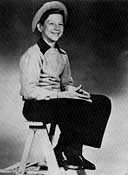
Donald,
The Movie Star |
Donald made his film
debut at age 11. He began by doing
an uncredited "specialty routine"
with his brothers in the 1937 Warner
Brother's musical Melody for Two.
According to some accounts, his part
in the picture didn't even make the
final cut. In any case, it apparently
made very little impression on Donald,
who considers 1938's Sing You Sinners
as the film "that started my first
official career in pictures."
2
"The first
time I was discovered for movies was
in 1938, at the Ambassador Hotel in
downtown Los Angeles. We were doing
a benefit for the Motion Picture Relief
Fund," Donald remembered. |
| "We did our act and there was
a man who worked for Paramount Studios.
He saw me, got in touch with us,
and I went over and got the part
for Sing You Sinners."3
The film starred Bing Crosby who
reportedly asked while working with
young Donald, "Isn't there anything
he can't do?"
"Bing Crosby was wonderful to me,"
Donald recalled. "The one thing
he kept reminding me was that I
didn't have to yell. I was always
working to the balcony, and he told
me the microphone would pick everything
up, so I could calm my voice down.
He was a tremendous help, very encouraging,
always patting me on the back."
4 |
Donald adjusted quickly to the new
demands of motion pictures. "Not being
on stage or in front of a live audience
was very strange," he recalled. "I
did a lot of looking and listening,
and figured that the camera was the
audience, but it was still strange,
learning dialogue and all that. However,
I fit right into it. Even as a kid,
I realized it was just an extension
of what I was doing on stage."
5 |
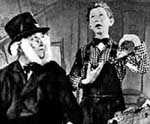
Donald
with Bing Crosby |
During his first Hollywood career,
from 1938 to 1939, Donald made eleven
films, usually portraying an orphan
or a younger version of the film's
lead, most notably as a young Beau
in Beau Geste (1939). Despite
his years of vaudeville experience,
Donald didn't think his dancing skills
were adequate for film. "In the vaudeville
act I looked like a great dancer,"
he recalled. "But I only knew a couple
of steps, some triple wings and such.
I'd never learned the fundamentals.
I didn't know the basic steps. So,
when I went into movies when I was
thirteen, I was fumbling all over
the place because I had nothing to
fall back on. It took me forever to
learn the dance routines. I really
had to woodshed for years and years."
6
.......
As he approached adolescence he began
to perceive another disadvantage to
show business. "I saw how other boys
could stay home and play and I resented
having to go to a studio every day,"
he said. "I remember once, all us
kids started building a playhouse.
I couldn't stay and finish it because
I had to go to work. So the kids started
to tease me. 'Look at the big movie
actor,' they'd say. I didn't resent
what they said; I only resented having
to go away and leave them."
7
.......
Donald's burgeoning film career was
shelved when he was summoned back
to vaudeville in 1939. "Things got
pretty rough. My brother Billy died,"
8 [of Scarlet Fever
at the age of 26]. My family was getting
ready to tour Australia," remembered
Donald, "and everyone was depending
on me to be in the act, so my mother
never took me back to Hollywood.
9 I stayed with the
act until the early part of 1942."
10
Recently, Peggy Ryan recalled an encounter
with Donald in 1941: "I was at the
Mansfield Theatre, and he was doing
vaudeville with his family. He called
and said, 'I got an audition across
the way for a show called Best
Foot Forward. Let's do "Fellow
and a Girl" from Meet the People
[the show Peggy was in at the time].
We're a shoo-in.' Now even though
I was in a Broadway show, I'd never
done a real audition before-it was
all a first for me. We had to wait
in the back, and we were given a number.
When it was our turn, we walked onto
the stage. About halfway through,
they say, 'All right. Next!' We really
bombed. We went outside and we were
so despondent-now here I'm in a show,
he's doing well, and we couldn't even
get past the audition! We got even
though. A little later when we're
at Universal, doing our movies, they
tried to borrow us to do the leads
of Best Foot Forward, and we
said, 'No!'" 10
The Elvis
of His Day
"When I was at Universal, making
millions of dollars for the studio
-the Elvis Presley of my day- the
guards at the gate never knew who
I was." -1984 1
In 1942 Donald was re-discovered
by Hollywood "I was discovered a
second time by another talent scout
while working at the Stratford Theater
in Chicago. 2
He saw me and sent us the money
for me to go out and make a picture
called What's Cookin'?, with
Gloria Jean, Peggy Ryan and the
Jivin' Jacks and Jills,"
3 remembered Donald.
"I had already passed the awkward
stage, which is death for a young
actor, and I guess they had forgotten
enough about me to re-hire me as
a fresh new personality."
4 |
The Jivin'
Jacks and Jills were Universal Studios
new teenage dance troupe. Peggy Ryan
remembered: "Six couples were chosen
for the best dancers in Hollywood
for that age group, twelve through
seventeen. I was seventeen then, Donald
was sixteen. And that was the next
time we met. We both got in the Jivin'
Jacks and Jills, and I was partnered
with him because we were the tallest
ones."
According to Peggy, for their first
film together the troupe was credited
en masse as "The Jivin' Jacks and
Jills" in 1942's What's Cookin'?,
but she and Donald quickly clicked
with audiences. |
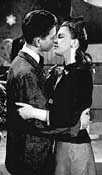 It
Comes Up Love with Gloria Jean
It
Comes Up Love with Gloria Jean
|
"They used to preview the movies
in Bakersfield," said Peggy. "And
they'd sent out cards for the audience
to fill out, what they liked and so
on. For What's Cookin'? the
cards all asked, 'Who are the dark-haired
couple?' The next picture we got billing!"
Their roles and popularity increased
on their subsequent films together,
until "we were the Judy and Mickey
of Universal," said Peggy.
5
Donald's distress over what he saw
as his inadequate dancing ability
increased as he compared himself with
his fellow Jivin' Jacks and Jills.
"I was working with all these great
dancers and trying to learn these
things from Universal's choreographer
Louis DaPron. I couldn't learn them.
I looked lousy up there with all those
other kids. I was becoming a bigger
star all the time," Donald recalled.
"They got to a point they were shooting
so fast they didn't have time for
me to take all day and learn the dance
routines. So when I was a big star,
they sent me to Johnny Boyle to teach
me how to dance! I was with him for
two weeks, and he gave me a letter
to give to the studio. And in the
letter it said that I was unteachable.
I drove him crazy. And he drove me
crazy." 6
.......
Donald's dancing skills were not his
only cause for concern as a young
star in the then powerful studio system.
"I was making a lot of money for the
studio, but I wasn't getting any,
and was working all hours," said Donald.
"There were laws to protect minors
at that time, but they didn't seem
to apply to me. As long as I got my
three hours of school nobody cared
how long I worked. They tried to finish
all those pictures before I went into
the service. We worked three pictures
at one time: the one coming up, the
one we were doing, and we dubbed the
one we'd just finished. That's all
we did: work. It's amazing we had
as much fun as we did grinding them
out like that. 7
.......
"The studio had a complete staff
to handle my mail [30,000 to 40,000
fan letters a month]," Donald remembered
"and my family had to hire a private
concern to take care of the overflow.
I was never involved in answering
it because I was always working. I
never knew how important I was. If
I had, I would have asked for more
money!" 8
|
| 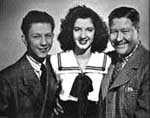
Peggy, Donald, Jack Oakie in The
Merry Monahans
|
Peggy Ryan
recalled that they were thankful at
the time to be earning as much as
they did. "At the end I might have
been making three hundred and twenty-five
dollars a week, and he might have
been making six hundred. We would
get a bonus of five hundred dollars
a movie. We thought that was the world."
9
Donald actually never
saw much of the money he did earn. |
"I lived on an allowance
and whatever I could snitch from my
mother's pocketbook."
10 His mother was in
charge of all his finances and according
to Donald, "She knew nothing about
business."
At seventeen, he decided to take over.
"I ran over and got my checks before
Mother got them. Don't misunderstand,
I was never denied anything. I had
my tailor-made suits, patent leather
shoes, my spats. But I didn't take
hold of my money until I was seventeen."
11
Donald's second film career ended
when, having turned eighteen, he was
drafted into the Army. Throughout
the remainder of WWII, Universal continued
to release the very popular and profitable
Donald O'Connor/Peggy Ryan films they
had rushed into production. "Donald
went in the service-he was eighteen
and I was nineteen by then," remembered
Peggy. "Universal had fourteen movies
that were released over the next two
years. I was nineteen forever!"
12
Greetings, Donald!
Bing Crosby: Greetings, Donald!
Donald O'Connor: Funny thing, that's
exactly what the president said
to me. - Fed. 2nd 1944
1 |
| Once in
the army, Donald was assigned to Special
Services and he was given the befitting
task of entertaining his fellow soldiers.
During his stint he gave over 3,000
performances. "I used to entertain
troops. A lot of guys who were disabled
or badly wounded were coming in from
overseas and it was my job to bring
smiles to their faces," Donald remembered.
"They wanted to make me an officer,"
he said. "But how could I have entertained
those men if I wasn't one of them?
I refused the rank. But just before
I got out they promoted me all the
way up to Pfc." 2 |
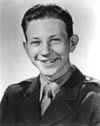
Donald
in the Army |
The day before reporting
for duty on February 7th 1944, Donald
married actress and childhood sweetheart
17-year-old Gwen Carter. He doesn't
mention his first wife (they were
divorced in 1954) at all in recent
interviews, but he did discuss their
relationship in a 1949 article. "I
don't know what would have been the
story of our marriage if the army
hadn't stepped in and decided they
could use me," Donald mused. "I was
away for most of our early married
life-and I think now it was a good
thing. The army aged us, as far as
marriage was concerned, much faster
than we would have grown up under
ordinary circumstances.
"It's a wonder to me now, looking
back on everything, that I had enough
good solid sense to consider marriage,"
said the 23-year-old Donald. "And
it's even more surprising that Gwen
and I were as realistic about it as
we were. We knew tying the knot was
not a hit or miss proposition and
that we would want a family some day.
We even went so far as to discuss
the future. Oh, we were very profound
for a couple of young kids.
.......
"I know now I was being typically
young in my reaction to my marriage,"
he continued. "I had so many interests
and was doing so many things that,
at times, I wasn't able to express
fully and consistently the real affection
I felt for Gwen. I suppose my attitude
was typical of all young kids who
are bent on having a time. It's tougher
to grow-up in a marriage when you're
young than it is if you marry when
you're a little older."
19-year-old Donald and his young wife
quickly had the additional responsibility
of a new baby when their daughter,
Donna Gwen, was born in August of
1945. "It was darned hard for us to
realize at first that she was our
baby. We kept thinking that we were
just taking care of someone else's
child," said Donald in 1949. "Once
I realized that I was actually a father,
I began to look at things more solidly.
This was definitely a contributing
factor to my growing up. I knew I
had to build a future not only for
Gwen and me, but for Donna."
3 |
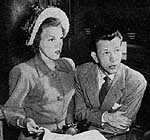
Gwen and Donald
O'Connor |
Donald
re-entered civilian life in 1946 and
films in 1947. "When I got out of
the army and had money to do with
as I pleased, I could think only of
making as much as possible. I went
out on personal appearance tours,
I did radio broadcasts, and I made
as many pictures as possible."
4
"The first
picture I made after I got out of
the service was with Deanna [Durbin],
Something in the Wind," Donald
recalled. |
| 25-year-old Deanna was the reigning
queen of the Universal lot and one
of the highest paid stars in Hollywood.
She had a reputation for being difficult
with her fellow performers. "You
hear a lot of stories about how
she was stuck up, temperamental,
hard to get along with. It wasn't
that at all," said Donald. "It got
to a point where she could no longer
perform. She could no longer work
if there were any strangers around.
It had nothing to do with temperament.
She was going through a traumatic
situation. Personally and professionally,
she couldn't cope with it. She got
to a point where she had to make
a decision: to keep on like that
or quit. She chose not to work any
more." 5
(Deanna Durbin retired in 1948.)
Donald still had his own problems
with Universal, some of them artistic
and some of them monetary. "The
only time I ever got any real money
out of the studio was when they
sent me to South Africa at twenty-one
to cement relationships between
the Schlesinger chain of theaters
and Universal. Schlesinger's thought
they might leave Universal and go
with J. Arthur Rank. I was the goodwill
ambassador; Schlesinger stayed with
Universal.
"When I got there a guy from the
studio said, 'We have some frozen
funds here if you want to call upon
them.'
"I said, 'How much do you have?'
"He said, 'At the moment, we have
about forty-five thousand pounds.'
"I said, 'Well, that's wonderful.
We'll start with that.'
So we started with that and we had
a ball. The pound was worth a lot
in South Africa at that time. I
even brought elephant tusks back.
If I could have got a live elephant
on the plane, I would have brought
that too." 6
At the time, the young star wasn't
complaining even though he believed
the studio, "often thought of us
as recalcitrant children."
7 His vaudeville work
ethic still prevailed. "My work
keeps me pretty busy. I have to
spend a lot of time before a picture
actually begins in rehearsals for
the involved dance routines, such
as I had in Curtain Call at Cactus
Creek. But I enjoy my work so
I don't mind the extra deals handed
me," Donald said in 1949.
8
He was cast in a few other minor
musicals (essentially all Universal
musicals were minor, compared to
the big budget extravaganzas of
the major studios), including Curtain
Call at Cactus Creek, Feudin'
Fussin' and a Fightin' and Yes,
Sir That's My Baby. But the
studio seemed to have had some difficulty
in finding a post war niche for
their now "grown-up" star. In 1949
Donald O'Connor had definite ideas
on the subject of his future career:
"Now I'm taking it far more seriously.
I've set up a pattern and I've been
forming plans as to where I want
to go in this business. In short,
I have a goal in mind for the first
time. I realize now the importance
of my job, and the demands it must
make of me if I'm going to get anywhere."
9
.......
He couldn't have planned for, or
even imagined, the turn his career
was about to take.
The "Mule and Me" Era
"The call I got from Bill Goetz
(the boss at Universal-International)
was the beginning of what I call
the "mule and me" era of my life
- with me working my brains out
to score and Francis stealing every
scene." - 1968 1
|
In 1949
Donald landed the role of Peter Stirling
in Francis the Talking Mule,
a project which led to a six-year
partnership in an extremely successful,
if not critically acclaimed, film
series. "I didn't know there was going
to be a series of Francis movies.
I thought there would only be one
movie, but they were so successful
that they made an absolute fortune
for the studio. I ended up making
one a year for six years."
2
Francis made Donald O'Connor an even
bigger star and Universal-International
millions. Despite their unanticipated
success and enduring |
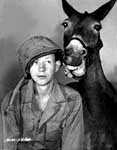
Donald and Francis
|
popularity, Donald's
attitude toward the films and his
co-star has been a rather ambivalent
one over the years. "Lord, how I hated
making them!" 3
he exclaimed in 1968.
"I
used to think of it as a bring-down,"
he conceded. "I'd make a film like
There's No Business Like Show Business,
then have to go back and work with
a jackass." 4
Donald may have resented the fact
that Francis once cost him a leading
role in Irving Berlin's White Christmas
(1954), which would have re-teamed
him with his Call Me Madam
co-star Vera-Ellen. "Bob Alton had
already put a lot of the choreography
together for me but I got this strange
disease and the doctors couldn't diagnose
it and it turned out to be Q fever."
5
Q Fever is an illness transmitted
by ticks and usually spread by cattle.
"It was either Francis or one of his
stand-ins," he said glumly. "The studio
waited six months, but when I came
out of the hospital I was so weakened
by antibiotics I just had to tell
them to go ahead without me.
6 I was terribly disappointed.
And Danny Kaye [who replaced him in
the film] made twice the money I would
have gotten and he got a piece of
the picture. You can see the movements
used look like something I would have
done." 7
"Irving Berlin was devastated,"
8 he added. |
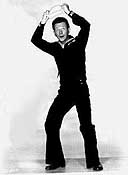
Publicity photo for
Francis Joins the Navy
|
As time passed Donald
gained more objectivity (or maybe
that's nostalgia) on the subject.
In 1995 he stated: "I liked the people
I worked with in the Francis
movies, but I didn't like the management.
9 It was wonderful at
first," he admitted. "But after three
pictures Francis started getting more
fan mail than I did and I said, 'This
can't happen.' 10
In between, I did Singin' in the
Rain or Call Me Madam,
but all people remember are the Francis
pictures. They made so much money,
so I guess I can't blame 'em for wanting
to crank them out. 11
I didn't make the seventh and final
movie, Francis in the Haunted House
(1956), because I didn't want to be
in any more Francis pictures," Donald
remembered. |
"I also didn't want
to be at Universal anymore. I volunteered
to do Francis in the Navy if
I could get out of my contract. So
I did that, and I was released from
Universal." 12
Donald's attitude towards the Francis
films has mellowed considerably. "Those
movies were ridiculous," he said in
1997. "But they were well put together
and a lot less crazy than some of
the stuff they're making today."
13 They were a lot of
fun, and gave me a chance to get away
from the song-and-dance thing." In
recent years he has even periodically
(and seriously) discussed reviving
Peter Stirling and Francis for a new
film.
.......
He also now fondly recalls his co-star.
"I had as good a relationship with
it as one could have with someone
who's been neutered. Francis never
attempted to hurt me in any way or
step on me, even when I would walk
behind him and hold on to his tail.
He was the most docile animal I've
ever worked with. 14
Francis had three understudies, but
nine out of ten times, they'd balk
and he'd have to do it anyway. He
was a trouper," 15
remembered Donald.
.......
"Francis
retired from motion pictures and went
into politics," 16
he quipped.
Singin' in the Rain
"The Musicals of my era were
important. They carried us away
into another dimension, and we found
a kind of truth in the musical.
We saw that mankind could have a
glow - that life could be singin'
in the rain." -- 1992
1 |
| In
1951 Donald O'Connor was offered
the role which would afford him
the most acclaim of his career and
a permanent place in film history.
MGM had requested him for the role
of Gene Kelly's sidekick in Singin'
in the Rain and had promised
Universal $50,000 for his services.
"Although flattered," he said of
the MGM offer, "I said 'no', because
in those days, under the terms of
contract, I wouldn't have seen a
penny of |
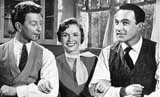
Donald O'Connor, Debbie Reynolds,
Gene Kelly |
that fifty thousand.
Finally Universal agreed to give me
the money, so I said okay."2
Donald was not the first actor to
be considered for the part of Cosmo
Brown. It had originally been conceived
of as a role for Gene Kelly's An
American in Paris co-star, Oscar
Levant. Levant was producer Arthur
Freed's personal choice, but Gene
Kelly and Stanley Donen, the film's
directors, insisted on casting a dancer.
"Arthur had a fit," said Donen, "But
said, 'All right, who do you want?'
And I told him, Donald O'Connor."
3
.......
"At that time, I was terribly
busy. I was doing The Colgate Comedy
Hour on TV. I was doing the movies
and personal appearance stuff,"
4 Donald remembered.
"By then I was bigger than Gene Kelly,
or anybody in Hollywood and Singin'
in the Rain only added to it.
5
.......
"I went over and met with Gene. I
had seen him in movies and always
liked him. It sounded great,"
6 remembered Donald.
"He was telling me about Singin' in
the Rain, explaining to me about our
characters, that we grew up together,
we danced together-our hands in the
same position, we look the same place,
leap to the same heights. Oh, everything
sounded wonderful." 7
But Donald still had one concern:
"You see, all my heavy dancing starts
from right to left unlike most dancers
who go left to right. With regular
choreographers putting down taps I
go nuts; they have to transpose.
8 That's why I drove
Louis [DaPron] crazy, and everybody
else. 9
I fretted about that all night and
the next day I went in to see Gene
and he said, 'Which way do you turn?'
When I said, 'To the left.' He said,
'Thank God. So do I'."
10
.......
Although Singin' in the Rain
contains the musical number which
director Stanley Donen refers to as
"The best tap number that has ever
been done in pictures,"
11 'Moses Supposes',
it is the acrobatic, energetic and
hilarious "Make 'Em Laugh" for which
Donald O'Connor is most renowned.
Gene Kelly, who superbly choreographed
the rest of the film, readily admitted,
"All of that number came out of Donald."
12 |
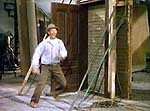 Donald, making 'em laugh
|
.
"They didn't have a solo for me,"
Donald remembered. "I couldn't think
of anything and just by chance [composer-arranger]
Roger Edens came in with this number
'Make 'Em Laugh.' Kelly said, 'Why
don't you take the girls -his assistants-
'and a piano player and see what you
can come up with.' 13
So I started ad-libbing and doing
pratfalls, and whatever they laughed
at the most we used. 14
|
| "I
couldn't think of a finish for the
number until I remembered I had
done the run-up-the-wall in two
other pictures, but never where
I run up two walls, and go through
a third. That was the perfect finish.
15
"I was smoking four packs of cigarettes
a day then, and getting up those
walls was murder. They had to bank
one wall so I could make it up and
then through another wall,"
16 recalled Donald.
"We filmed that whole sequence in
one day. We did it on a concrete
floor. 17
My body just had to absorb this
tremendous shock. 18
Things were building to such a crescendo
that I thought I'd have to commit
suicide for the ending.
19
"I came back on the set three days
later. All the grips applauded.
Gene applauded, told me what a great
number it was. Then Gene said: 'Do
you think you could do that number
again?' I said: 'Sure, any time.'
He said: 'Well, we're going to have
to do it again tomorrow.' No one
had checked the aperture of the
camera and they fogged out all the
film. 20
So the next day I did it again!
By the end my feet and ankles were
a mass of bruises."
21
.......
In the endless analysis which the
film now engenders, even this seemingly
straightforward comedy dance does
not escape over interpretation,
such as: "It is Cosmo's dancing
in the 'Make 'Em Laugh' sequence
that most approaches slapstick's
comic recontextualising of the everyday
object." 22
[Quick, boy, the dictionary.]
.......
"We knew Singin' in the Rain was
going to be a very good picture
from the dance numbers and the quality
of the dailies we were seeing,"
recalled Donald. "Most of the fun
was during rehearsal. We had a lot
of laughs, but once we got into
the movie Debbie and I kind of shut
up because Gene had the monumental
job of not only acting in the movie,
but trying to pull it all together
as co-director [with Stanley Donen]."
23
.......
19-year-old Debbie Reynolds found
the filming particularly difficult.
"I found myself crying on the soundstage,
doing everything in my power to
hold back the tears," she remembered.
"My feet were killing me. I was
so overwhelmed, so intimidated.
I couldn't understand why Gene was
being so hard on me." And she couldn't
understand why he was being so hard
on Donald either. According to Debbie,
"Gene would get mad at Donald and
tear into him. 'You're so stupid;
you're not doing the step right!
You're stupid!'
.......
"It wasn't until thirty-five
years later that Donald told me
the reason Gene always picked on
him: It was because he was always
mad at me. But he realized if he
kept screaming at me, I'd probably
hold up production with my tears.
So he screamed at Donald, who wouldn't
cry." 24
.......
Donald recounts the incident a little
differently: "I got to the set and
after a few steps Gene shouts at
me, 'Stop the clowning, will you?'
Later on he apologized for chewing
me out and said, 'Listen, Debbie
hasn't been coming along as I had
hoped, but I couldn't ball her out
because I didn't want to lose her,
so I took it out on you.' I told
him, 'That's okay, Gene, I understand.
But the next time you do it I'll
kick you in the balls.'"
25
.......
Despite the hard work and
the tension on the set, Donald claimed
that if he had a favorite film,
"It would be Singin' in the Rain,
because of all the fun we had in
rehearsal." 26
He won a 1952 Golden Globe award
for his work in the film.
"It's not
easy working with a genius - but
Gene was very patient with me."-1988
The Youngest Old Timer in Show
Business
"I was born and raised to entertain
other people. I've heard laughter
and applause and known a lot of
sorrow. Everything about me is based
on show business - I think it will
bring me happiness. I hope so."
--1955 1
After Singin' in the Rain
Donald was increasingly in demand
for big budget musicals, while at
the same time he continued with
the Francis Films for Universal
and as a TV entertainer. "Making
the transition to television was
no problem for me. I liked it because
we brought in the audience. The
only [bad] thing was the lack of
time to do anything complicated."
2
|
| Unlike
the other major studios, Universal
didn't have any rules against their
contracted stars performing on television.
Donald embraced the new medium, overwhelming
early TV audiences and critics alike
with his abundance of talent. "There
doesn't seem to be a limit to his
ability to capture an audience and
then hold them," reads a 1952 New
York Times review of The Colgate
Comedy Hour. "O'Connor held them
as few performers in the business
today can. O'Connor sings. He dances.
He reads lines. And he does all of
these superlatively. Added to this
is an ingratiating, boyish charm and
showmanship that no script could dictate."
|
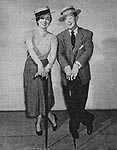
On
The Colgate Comedy Hour
Patricia Morison and Donald
|
In 1952 Donald received an Emmy
nomination as Most Outstanding Television
Personality. In 1953 he won the award
for Best Male Star for his performances
on The Colgate Comedy Hour.
That same year, despite his heavy
TV schedule and his contractually
required appearance in the Francis
series, Donald's musical film career
was in high gear. "I was very hot
at that time," 3
he admitted. He starred in three big
screen, Technicolor musicals for three
different studios in the same year:
Universal's Walking my Baby Back
Home, I Love Melvin for
MGM and Call Me Madam at Twentieth
Century Fox. "I lived a crazy life
back in those days," he said. "But
I sustained by always going back to
work and hearing the applause."
4
.......
There was no shortage of applause
for Call Me Madam, the Ethel
Merman vehicle which marked her return
to the screen after fifteen years,
and showcased Donald's myriad talents
as well. The film's standout number
is a marvelous duet, with Ethel, of
the Irving Berlin song(s) "You're
Just in Love/I Wonder Why." But Donald
found that working with Miss Merman
had its hazards. "We started singing
'I hear music…' She was six feet away
and my eardrums were vibrating.
5 It was beautiful,
but you couldn't hear for four or
five days." 6
We finally recorded the song with
me in the isolation booth and her
in the studio with the orchestra.
When we filmed the song to the playback,
I wore ear plugs." 7
.......
Call Me Madam also gave Donald
his first and, as it turned out, only
opportunity to work with Vera-Ellen,
whom he described as, "a marvelous
gal who made me look good." And he
added, "She was extremely sweet-so
very sweet-and she always had that
smile on her face." 8
.......
While he's hesitant to select a favorite
film, he's quick to single out his
favorite performance: "Call Me
Madam -my favorite number is in
there with Vera-Ellen. It's the number
I do out in the garden with her to
'It's a Lovely Day Today.' It's a
beautiful lyrical number. I think
she was the best dancer outside of
Peggy Ryan I ever danced with.
9 I know for a fact
that Astaire and Kelly truly respected
her as a dancer. You can tell from
the way they danced with her that
they felt she was someone truly special.
10 |
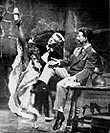
Donald
with Vera-Ellen in Call Me Madam
|
"Vera was
a physical dancer like me. She could
adapt her style, and Call Me Madam
had every kind of number you could
think of. When we danced together
the great thing about her was that
she didn't try to upstage you. Women
dancers sometimes try to lead. We
worked together and every movement
we did meant something."
11
The admiration was mutual and Vera-Ellen
once declared, "Donald O'Connor taught
me the sheer joy of dancing."
12 |
With their complimentary performance
styles and personalities, they seemed
destined for future screen pairings,
but plans to reunite them, like White
Christmas, never worked out.
.......
Donald did reunite with Debbie Reynolds
in 1953 for MGM's I Love Melvin.
The film was made on location in New
York. Although it has its moments,
such as Donald's remarkable dance
on roller skates and Jim Backus' noteworthy
comic performance, I Love Melvin
was a disappointment for the studio,
its stars and its audience (perhaps
because of the mediocre score and
a poor script). Donald didn't have
much to say about the film except,
"Lousy picture." 13
Debbie Reynolds commented facetiously
that MGM had grossed about $4.50 during
the extravaganza's run.
14
.......
Even with Q-fever time off, for Donald
1954 was just as fast-paced as the
year before, with a full television
and film schedule. He seemed to thrive
on it. "I think I've learned to gratify
the audience instead of myself," said
Donald, "and it's a satisfying thing.
A real entertainer would rather give
than receive." 15
He continued as rotating host of the
Colgate Comedy Hour and also
hosted the second televised Academy
Awards. Later in the year he began
working on The Donald O'Connor
Show, a biweekly program (alternating
with the Jimmy Durante Show),
for Texaco Star Theatre.
.......
Besides his requisite appearance in
the Francis film of the year (Francis
Joins the Wacs), his only film
role in 1954 was in There's No
Business Like Show Business, with
Ethel Merman, Marilyn Monroe, Dan
Dailey, Mitzi Gaynor and Johnny Ray.
It was a volatile cast and the clash
of wills and personalities was unavoidable.
Donald recalled the making of the
film as traumatic. 16
.......
Marilyn Monroe had skyrocketed to
super-stardom in 1953's Gentlemen
Prefer Blondes, and Fox devoted
much of the film's publicity to their
hottest star, but she was reluctant
to do the film. She thought the script
and her role were shallow. [Maybe
she had a point there.] Her performance
and her behavior on the set clearly
demonstrated her discontent. Donald
remembered her as, "scared" and "insecure."
17 She may have found
the cast of seasoned stage professionals,
particularly Ethel Merman, intimidating.
.......
There was no love lost between Marilyn
and her other No Business co-stars,
who quickly became annoyed with her
incessant tardiness and constant demands.
She had to have her own dress designer,
her own choreographer and her own
acting coach. Ethel Merman found the
prima donna antics hard to take. "I
found a way to keep Ethel cool," said
Mitzi Gaynor (who would develop a
life long friendship with the Broadway
star). "Whenever Marilyn wouldn't
come out of her dressing room, I gave
Ethel a wink, hinting that something
naughty was going on in there. Of
course that wasn't true, but if Ethel
thought maybe some hanky-panky was
going on, she could enjoy the situation."
18
.......
Marilyn's complaints didn't stop with
the choreographer and the costumes.
She also found fault with Donald,
complaining that he looked too young
(he was actually nine months older
than she was) to be playing her love
interest. She also objected to the
romantic scene with him, which she
had to play without shoes, so as not
to appear taller than he was. Donald,
however, was characteristically gracious
towards his difficult co-star. He
remembered: "With Marilyn, she had
this phobia. I told everybody about
it: that she was afraid to get in
front of the camera. She was scared
to death." 19
|

Ethel
Merman, Dan Dailey, Mitzi Gaynor,
Donald and, Marilyn
Monroe |
Donald
recalled that they were both nervous
about their screen kiss (and their
trepidation was not lessened by Marilyn's
conviction that her husband, Joe DiMaggio
was having her followed by detectives.)
By the time the moment came there
were over 1000 onlookers who had drifted
over from other sets. |
"I don't know what everybody was
anticipating - some explosive thing
between Marilyn and myself," said
Donald. [They must not have been
watching the dailies.] "But I'm
not really that gregarious, that much
of a show off in front of people.
20 My lips
were shaking all over and I couldn't
find Marilyn's lips and she couldn't
find mine, and I had to turn my back
to the camera so the audience couldn't
see these four lips trying to find
each other. 21
So, I got it over with as quickly
as possible. I couldn't enjoy the
moment, and it was like kissing the
sidewalk." 22
.......
Adding to the tension on the set were
Donald's own marital problems. He
had separated from Gwen, his wife
of ten years. She and Dan Dailey,
who played Donald's father, were dating
during the shooting of the film. After
filming wrapped, the O'Connors divorced
and shortly thereafter Gwen and Dan
married. There's No Business Like
Show Business opened to mixed
reviews.
Leaving
Universal
I didn't want to make a jackass
of myself. -- 1996
1
By 1955 Donald had become increasingly
dissatisfied with his role as Universal's
resident 'nice boy'. "I'm no angel,"
he declared at the time. "I'm the
same as everyone else, with the
same temperament and temper. I resent
having people tag me as a perpetual,
super-polite juvenile. I'm subject
to fever and headaches and bad-temper
just like anybody else."
2
He'd had enough of the Francis films
as well. "I told the studio I wasn't
growing, that I wanted to become
a man on screen instead of playing
all those silly parts. Finally,
I refused to make another Francis
picture unless they released me
from my contract. I don't know where
I got the guts to do it, but they
said, 'Okay.'" 3
.......
"When I left Universal after something
like fifteen years, after I had
made hundreds of millions of dollars
for the studio, they had a nice
little party for me in the commissary.
And they gave me a nice little Minox
camera with fourteen roles of film.
That was my going away present.
.......
"What else can I tell you about
those people?" 4
|
| Donald's
only film in 1955 was Francis in
the Navy, his swan song for Universal.
His TV schedule however was still
full and he was once again nominated
for an Emmy, this time as Best Specialty
Act. It was also the year in which
Donald conducted the Los Angeles Philharmonic
in the world premiere of his symphony,
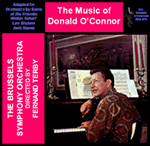
"Reflections d'un Comique." (In 1960
the Brussels Symphony Orchestra would
record the piece for an album entitled
"The Music of Donald O'Connor.") |
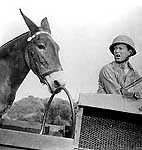
Francis
and Donald in their last picture
together |
His only film in 1956, Anything
Goes, featured his Sing You
Sinners co-star Bing Crosby. "In
1938 I'd played his kid brother and
he was protecting me all the time,"
said Donald. "But when I did Anything
Goes we were to be buddy-buddies
of about the same age and it was very
difficult for me to relate to Bing
at that time. I had become really
enamoured with him, star struck, which
I'm not prone to do with people; but
with Bing, yes. 5
"Then a funny thing happened.
You've heard that nobody could ever
get close to Bing. You'd talk to him
and then he'd leave. So, during this
picture, I didn't want to bother him
and I kept my distance. I knew he
was busy. He had other things to do
besides acting. One day a mutual friend
said, 'Donald, do you like Bing?'
I said, 'Of course. I love him. Why?"
And he said, 'Well, Bing doesn't think
you like him. He feels he can't get
to you.' Bing laughed when I told
him about it." 6
.......
Anything Goes was Donald's last
appearance, to date, in a musical
motion picture. [No, Alice in Wonderland
doesn't count. Out to Sea almost
does.]
.......
Donald married again in 1956
to his current wife of over forty
years, Gloria Noble. Their daughter
Alicia was born the next year. She
was followed by a son, Donald Frederick,
in 1960. A second son, Kevin, was
born in 1961.
.......
In 1957 Donald took on one of his
few dramatic roles, starring in The
Buster Keaton Story. "I wanted
to do the picture because the idea
of playing Buster Keaton was thrilling,"
said Donald. "He grew up in vaudeville,
and our lives paralleled each other,
so I found it an honor to be doing
his life story." 7
|
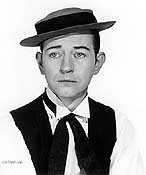
Donald as Buster Keaton
|
Once
they started filming Donald didn't
find it so thrilling. "I got into
all kinds of trouble because I thought
the picture should not be made if
it wasn't absolutely true to his personality
and the facts of his life. Nevertheless,
I was committed to the project and
I had to finish it, which I did under
duress. 8
.
"A terrible film," he said.
"Keaton was always big-locomotives,
hurricanes-as opposed to Chaplin,
who, apart from Modern Times
with the factory, thought small. Every
comic has his own signature. Keaton
was the D.W. Griffith of comedy. They
missed it all. Sixty percent of the
story is fabricated."
9 |
"To me it was so damned dishonest.
It wasn't Buster's life. They called
him a technical advisor, but they
never listened to him. I remember
talking to him right after we'd shot
a scene of him as a boy in the circus
going on for his father who had just
died. I asked Buster, 'What kind of
circus was it?' He kind of looked
at me and said, 'I never was in a
circus.' So I asked him, 'Well, how
old were you when your father died?'
'Forty -five,' he said."
10
.......
"He needed the money," answered
Donald, when asked why Buster stood
for it. "And then he just didn't let
it bother him. Like the guy living
in this quiet house and suddenly it
is surrounded by whirling dervishes.
'What are you going to do about it?'
his friend asked. 'Nothin'. Let 'em
whirl.'" 11
.......
After The Buster Keaton Story,
Donald's film appearances became few
and far between. From 1957 to 1960
even his television roles, which he
had tackled at a break neck pace for
most of the decade became rare. Donald
had decided it was time to slow down.
"I was doing 19 one-hour shows a year,
plus a constant stream of movies.
And I was giving 100 percent of myself
even when it was junk because I'd
been taught this tradition of always
doing my best. I'd go and go until
I was ready to drop, then I'd check
into a hospital for six or eight weeks
just to get some rest and have my
meals served me. Finally I just had
to cut back." 12
Peaks
and Valleys
"I've always been able to fall
back on one thing or another, no
matter how many times I've had to
make a comeback, which probably
now numbers at least eight or 10."
-- 1992 1
|
| During the sixties Donald
made only occasional television appearances,
hosting a few variety programs and
specials, and guest starring on several
others. He also stepped in as guest
host on The Tonight Show in
1962 (when everybody was doing it.)
He guest starred on the first aired
and most highly rated hour of The
Judy Garland Show in 1963. In
1964 and 1965 he hosted three hour
long, lively and entertaining Hollywood
Palace programs. And in 1966 he
made an unsuccessful pilot for CBS
(The Hoofer 1966), with Soupy
Sales, no less. |
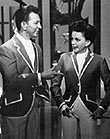
Donald
and Judy on her show
|
| Donald also exhibited his talent
in yet another facet of show business.
He made his directorial bow (if
you don't count episodes of his
own show) with a 1964 episode of
Petticoat Junction. The producers
of the rural comedy were quite pleased
with his work. "Your directorial
triumph on Petticoat Junction
merely proves once again what most
of us in this community already
know: that you are one of the industries
most gifted and most versatile talents."
2
Donald made only three films during
the decade, which included The
Wonders of Aladdin (1961). It
was made on location in Tunisia,
which strangely enough adds no authenticity
to the film. It's a silly 'Arabian
Nights' mish-mash, which hardly
seemed suited for his talents, but
"he gives his task the old junior
college try." 3
Cry for Happy (1961), filmed
on location in Japan, at least gives
him the chance to display his underused
dramatic ability. The film is billed
as a comedy, but there isn't much.
It would be another four years before
he returned to the big screen for
Universal's That Funny Feeling
(1965), another unexciting comedy
in which he's sadly underused. The
film stars Bobby Darin, Sandra Dee
and Donald. Bobby doesn't get to
sing; Donald doesn't get to dance;
Sandra doesn't know how to act:
a triple threat.
With film and television offering
so little, he fell back on his vaudeville
roots and returned to the stage.
In 1963 Donald appeared at the Hotel
Americana in New York City for the
then astronomical salary of $12,000,
the highest salary paid to any performer
in New York up to that time.
4 He also toured with
the stage musical Little Me
playing five different roles. He
continued to attract large audiences
for stage appearances in Las Vegas,
Reno and New York. But it seemed
Hollywood (and, by default, Donald
O'Connor) had given up the film
musical. The studio system, which
had both nurtured and restrained
him, had fallen and expensive musicals
were too risky.
In 1968 he had a brief run with
his own syndicated talk show, The
Donald O'Connor Show. After
it's demise, Donald's career was
eclipsed by a disastrous addiction
to alcohol. "Alcoholism was a disease,"
said Donald. "A genetic thing. I
used to have a marvelous time drinking,
until I passed that invisible line
and I became an alcoholic."
5
"Many interviewers have said, 'Donald,
you escaped it. We never read about
you being drunk or popping pills
or having arguments at home.' They
didn't hear about it because, one:
I've always kept a low profile;
and two; many people who love me
protected me. I went through the
booze bit," he admitted. "I didn't
escape it." 6
As his drinking increased, he began
missing dates and showing up drunk.
He quickly became a persona non
grata within the entertainment
industry. His wife, Gloria left
him (they reconciled after he sought
treatment), and he managed to alienate
his four children. 7
Despite his problem, Donald still
worked occasionally in the '70s
on television, expanding his repertoire
to include dramatic roles, including
a very effective performance on
a 1976 episode of Police Story.
His only film contribution during
the decade was as one of the many
hosts for 1974's That's Entertainment.
He had the arduous task of introducing
Esther Williams' film clips.
In 1978 Donald was hospitalized
because of his drinking problem.
"I figured I could master the program,
be out of there in a week, and go
back to drinking. But once I was
there something marvelous happened.
My obsession to drink left me. Now
I have been a recovering alcoholic
for fifteen and a half years,"
8 he said in 1994.
"Sobriety has been my savior," he
said. "And now I work with hope,
faith and trust." 9
In the 1980's, with his troubles
behind him, Donald approached his
career with renewed vigor. He made
a TV pilot for NBC called The
Music Mart co-starring his longtime
comedy and songwriting partner Sid
Miller and Gloria DeHaven, his first
date. "I think I was Gloria DeHaven's
first boyfriend. We were about 9
or 10," he recalled. "I would take
her to a movie, and we would go
down to the front, and her mother
would sit in the back."
10
The Music Mart was a flop. NBC
did not pick it up. |
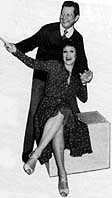
Chita
Rivera and Donald in Bring Back
Birdie |
Undaunted, Donald decided
to tackle a new (for him) frontier
in show business: Broadway. The show
was Bring Back Birdie and it
co-starred the enormously talented
Chita Rivera. It was a sequel to the
very successful Bye, Bye Birdie
of 20 years before. It was a flop…
a big one, running only four performances
in March of 1981. 11
In a recent interview Chita Rivera
was asked about the show. "That one
was tough," she concedes. "But I got
to work with Donald O'Connor."
12
.......
Donald also starred in a stage version
of Harvey called Say Hello
to Harvey! which debuted in Toronto,
Ontario in 1981. The production also
featured Sidney Miller and was intended
for Broadway, but… it was a flop.
|
Donald's next Broadway
effort, as Cap'n Andy in a 1983 revival
of Showboat, was a hit!
He toured with the show periodically
for many years.
After a 15 year absence from feature
films, Donald made an appearance in
Milos Forman's Ragtime. The
film marked James Cagney's last big
screen appearance. In it Donald sings,
beautifully, and dances, all too briefly.
But don't expect a musical. He's the
only one who does perform and that's
within the context of the story (and
he's rudely cut short.) His character
in the film is simply called Eleanor's
Dancer Instructor and he doesn't have
a lot to do. "I was in it only because
Jimmy Cagney didn't want to be alone
in England," Donald admitted. "It
was fun. Being around Jimmy was great."
13
Donald made frequent television appearances
in the 1980's, including the requisite
Fantasy Island and Love
Boat stints. [They did use
to give guest stars a free cruise:
that's hard to pass up.] He also
received an Emmy award nomination
in the category of 'Outstanding Individual
Achievement - Special Events' for
his impressive musical presentation
on the 1980 Academy Awards program.
Once again, towards the end of the
decade, Donald was forced to slow
down, this time by a heart condition.
After years of taking medication for
the problem, he decided surgery would
be the wisest course. "It made more
sense to have surgery while I was
in good shape," said Donald. "Than
to wait for a heart attack and take
my chances. My wife, Gloria, was with
me every step of the way. She didn't
leave my side, but then she never
has." 14
The decision to have surgery proved
to be the right one. "I don't need
nitro-glycerin pills anymore, so I
can work harder than I ever worked.
The surgery gave me a lot more energy."
15
Still Dancing
"I know what you're thinking,
and the answer is yes. I can still
leap over the furniture and dance
on the wall. And recite 24 bars
of that popular tongue twister 'Moses
Supposes.'" 1
-- 1992
In the 1990s Donald worked on
judiciously chosen television and
film projects. In 1992 he co-starred
with Robin Williams in Toys.
He gives a charming, but all too
brief performance. "I'm on screen
for about five minutes in that one,
but it's a very funny scene."
2
"I never got to see Robin," said
Donald. "Because my character died
before he came into the movie. We
didn't hang around the set or anything,
but he was very sweet. He sent me
a small leather bound copy of the
script and said he liked me playing
his father." 3
Toys was a critical and box
office disaster. [Really, simply
brilliant and too far ahead of its
time. Take our word for it. Or not.]
|
| Donald's television
efforts in the 90s include Murder
She Wrote, The Nanny and
Fraiser and in 1992 he gave
a standout dramatic performance in
HBO's Tales From the Crypt.
Also in 1992 Donald produced a work
out tape entitled Let's Tap.
Looking as youthful and energetic
as a man half his age, he gives instruction
on 12 different tap steps [and
a few others he kind of sneaks in].
|
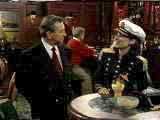
Donald
guest starring on The Nanny
|
With the video he seems to compensate
for his youthful frustration at not
"knowing the basics."
In 1994 Donald and Gloria had a close
brush with death. "Yeah, you could
say I saw my life flashing before
my eyes," said Donald. "It was about
four in the morning and I had just
finished reading this thing in bed.
All at once, the house started to
shake. We both knew what it was; but
most of the time, an earthquake will
either shake or roll. This one did
both and all of a sudden, the house
started sliding off its foundation,"
he remembered. "But luckily, the house
wedged up against this big tree and
that kept it from crashing into a
canyon."
"We now live in
Arizona," he added. 4
Donald declared that he was no longer
interested in working too hard in
1995. "I'd rather do something where
I go in and work a week, maybe three
days, get it done and come back home."
5 His resolve in this
regard seems to waver. Until he was
stricken with pneumonia early this
year, he continued to keep a hectic
schedule.
He co-starred in the 1997 Jack Lemmon/Walter
Matthau film Out
to Sea proving it was possible
[Well, almost] to steal a film
with less than ten minutes of quality
screen time. "Yeah. They didn't have
much for me in the movie. I didn't
want to do it at the beginning. Then
the gal who directed it [Martha Coolidge]
said that they would build up the
part. I was there for the entire picture
because being a dance host, I was
in all the scenes while they were
dancing. So I danced a lot in that
movie. I tell you, I got to hold a
lot of nice ladies - all sizes."
6
He has also been touring with a variety
show/nightclub act. "I'm out on the
road about thirty-two weeks a year.
It keeps me really busy,"
7 said Donald. "I do
a little singing, a little dancing,
a little storytelling: I guess a lot
like I used to do in vaudeville. I
hit upon some old stuff, like a little
Singin' in the Rain. I also
do some new things, even take some
pratfalls to get laughs."8
|
Donald
dances at the Follies
|
In 1998 Donald signed
on for The Fabulous Palm Springs
Follies, a revue featuring 54-year-old+
performers. He was their headliner,
dancing and singing his way through
eight performances a week until, on
January 30th, he became critically
ill. He had developed a case of double
pneumonia and was rushed to the hospital.
Follies producer, Riff Markowitz,
described the scene that night: "The
press were lining up across the street.
We had satellite dishes everywhere.
I mean, they just flocked to us from
all over the world, because it was
clear, in their minds that this dear
man was about to take a cab. I mean,
they felt it was over for him. [They]
felt that Mr. O'Connor would never
again, certainly not for a long time,
return to our stage or any stage."
9
Well, they were wrong.
|
At the peak of his
illness Donald was in critical condition
on a ventilator in intensive care
and doctors were giving him only a
30% chance of surviving. But he pulled
through and on March 1st he was released
from the hospital. "The rumors of
my death were highly exaggerated,"
Donald said in May. "And although
many people did not think I would
make it, I have bounced back because
of the support of my family, friends
and the Follies." 10
He also announced his intention to
close out the season with the Palm
Spring Follies. He did just that,
performing in the last four shows.
"I want to thank you for all your
prayers, and all that love you poured
out over all that time I was in the
hospital," he told the audience during
one performance. "It made me feel
awful good."
Only a few months after his brush
with death, Donald was able to joke
about the close call. "One of the
funniest things happened to me when
I was in the hospital. I was on a
gurney and I was going up in the elevator
with this nurse and we stopped at
this floor and this big gal got on
the elevator. And she said to the
nurse, 'You know, that looks exactly
like Donald O'Connor.' And she (the
nurse) said, 'Well, that is Donald
O'Connor.' And she said, 'Don't be
silly. He's dead.' I went on from
there. Although, it was quite some
time."
During his triumphant return performance
Donald asked the audience for requests.
"'Make 'em Laugh'? That's where I
run up the wall and do the back somersaults.
All right, we'll do that for you...
tomorrow at 12 o'clock. Oh, my heavens."
11
He continued to make occasional public
appearances for the next four years,
when not relaxing with his family
at his Sedona home. Despite failing
health in 2003, Donald made appearances
at the Roger Ebert Overlooked Film
Festival and the opening of the Judy
Garland Museum. Donald died on September
27th 2003 at the age of 78.
“I'd like to thank the
academy for my lifetime achievement
award that I will eventually get.”
-- Donald’s Last Quip |
Special thanks to
Donald O'Connor,
from whom we stole the title of
this epic: "The Last Song-and-Dance
Man." He once proposed it as a title
for an autobiographical stage play
he was preparing. |
And to
Kathy, The Tap Dancing
Cleveland Librarian, for providing
the research on which much of this
biography is based. |
Footnotes
and Bibliography

|
|

     
|
You have reached http://www.eviltwinltd.com/muppetlabs/oconnor/donald.htm
Disclaimer:
I am not officially sanctioned by or connected
to the late Donald O'Connor, his estate,
or anyone else for that matter. None of
the content of this website is meant to
infringe upon any copyrights held by studios,
companies, authors, other web site owners
or stray individuals. You will find no
frames on these pages since they give
me a touch of cyberclaustrophobia. Nor
is there any advertising (except for a
few Amazon links and those can't hurt
you) or pop up ads or anything else to
detract from the content, except perhaps
a warped sense of humor. Off-site links
will pop up as a new page, unless you're
on our "On-line" page where we assume
you really want to go somewhere else.
Anything original
is copyright 1999 - 2004
by Teresa and/or Tracy Murray (a.k.a.
T 'n' T).
 Please send me lots and lots of e-mail
at
teresa@eviltwinltd.com
Please send me lots and lots of e-mail
at
teresa@eviltwinltd.com
Number of people who were so impressed
with Donald O'Connor that they had to
come over here: 
Dentist Nashville
|
|

|
|
|
|