|
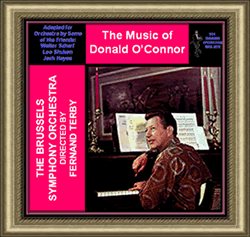
Liner Notes
Here the talents of a giant
of the entertainment world has now exerted itself
in the most precious avenues of Donald O'Connor's
life and the fulfillment is as complete as one
would dare. The themes and melodies exposed here
have long lingered in Don's soul and were helped
to brought alive by some of his friends. (Walter
Scharf, Leo Shuken, Jack Hayes).
The realization of the
music in its final completion, in orchestral form,
has and will urge the talents of this great entertainer
to go further and continue to bare his chest so
that the world will become richer in its new found
music.
WALTER SCHARF
SIDE I
(A) "INTRODUCTION AND
IDENTIFICATION" (:52)
This serves as an introduction and also introduces
thematically, "HERE COMES DONALD" in short form.
The taps on the woodblocks act as a liaison between
Donald's talent as an entertainer and his talent
as a composer.
(B) "DONALD'S WALTZ" (4:42)
The adaptation of
this glorious melody was comparatively easy because
it lent itself to the strings of the orchestra
and their response has created a thing of beauty.
Originally the Waltz was used as a theme for a
dance on one of Donald's television shows and
it's infectious quality demanded that it be put
in concert form as done here.
(C) "HERE COMES DONALD" (1:01)
The theme of this very charming piece is Donald
himself when performing. It has acted as introductory
music and exit music and anything that would identify
Don. His friends couldn't resist the temptation
of putting it in its form as used here exemplifying
a very stuffed-shirt woodwind ensemble plus harpsichord
playing as rigid and as traditional as possible.
At a moment's notice they break out into a slight
jazz and finally sink back into the rigidness and
stuffiness completing a delightful reading of a
delightful theme.
(D) "CHRISTMAS COMES ONCE A YEAR" (5:45)
Mr. Irving Berlin presented Donald with a special
piano which when one plays on the black keys, by
just sliding a lever, the black keys can become
the sound of the white keys.
In introducing "CHRISTMAS COMES ONCE A YEAR" his
friends tried to show how the composition was born,
exactly how Donald conceived it (on the black keys)
and the development that takes place therein so
that by its finale, it has gained all the musical
stature that it deserves. The acrobatics of the
adaptations are very subtly transcribed and a great
deal of credit must go to the musicians themselves.
SIDE II "REFLEXIONES D'UN COMIQUE" (15:05)
In 1956 Don was commissioned to conduct the annual
performance of the Doctor's Symphony Orchestra of
Los Angeles. For this performance "Reflexions D'un
Comique" was born. It's response was great and the
last movement had to be played twice to satisfy
an encore.
His friends advised that adding another five minutes
to this already brilliant work might make it a major
orchestral piece. So it went back to the score paper
and and out of it came the final result as heard
here.
This piece basically is Donald himself with his
many moods; the graphic line of emotion is so prevalent
throughout the work. It's descriptions orchestrally,
are brilliant and rise to the heights that the work
deserves. It also supplies a concerto quality with
the use of the piano as soloist throughout the opus.
This also is supposed to act as a parallel to Donald's
"Irving Berlin piano". Let the chips fall where
they may and explore a new talent."
(All Compositions published by ... O'CONNOR AND
MILLER MUSIC CORP.(ASCAP) Los Angeles, California.)
PALETTE RECORDS CORP. 1733
BROADWAY, NEW YORK 19, N.Y.
|
 Please send us lots and lots of e-mail at