| 
|
|
|
Monk Fun
Page Review:
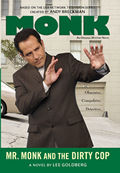
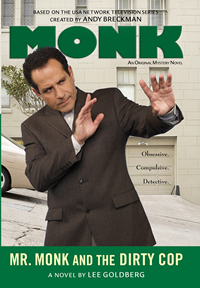
Mr. Monk and the Dirty Cop
by KC
 |
My
relationship with the
Monk novels did
not start immediately.
By the time I found them,
the first three were already
in print. When I started
reading them (slightly
out of order), I found
that they were fun weekend
books full of entertainment.
But after book 4 (Mr.
Monk and the Two Assistants),
I kind lost track of the
newer additions. Only
recently—as I was
kindly permitted to review
for the Fun Page—did
I start reading the books
again.
Once
I read all seven of the
available Monk
books, I was sure of my
original favorite: Mr.
Monk and the Blue Flu.
It was well-rounded and
hilarious. Though I have
enjoyed all of the books,
I felt like Blue Flu
would always be my favorite.
But then something unexpected
happened: I found a new
favorite.
|
Mr.
Monk and the Dirty Cop
starts off with a rather
timely topic, especially
in the great state of California:
budget cuts. Monk, and consequently
Natalie, are the subject
of such fiscal woes as the
San Francisco Police Department
terminates Monk’s
assistance, but as Monk
loses one job he instantly
gains another at a high-paying
private detective agency.
So things aren’t so
bad, Monk continues to solve
murders—with better
pay—and Natalie gets
a company car, credit card,
medical, a pay increase,
and—best of all—she
gets her own Natalie. Yes,
Natalie gets an assistant. |
But
even as Natalie gains all
the perks of Monk’s
newest endeavor, she spends
much of the book questioning
her place in the world.
Through this process of
self-discovery, Natalie
is given time to shine in
new ways as she takes more
chances and is more of a
partner to Monk than an
assistant. During one point,
when Natalie is finding
her place, she says, “I
felt a sensation that was
both mental and physical,
of things seeming to snap
into place. It was a feeling
I’m sure Monk would
have understood.”
|
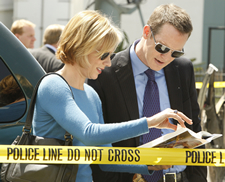
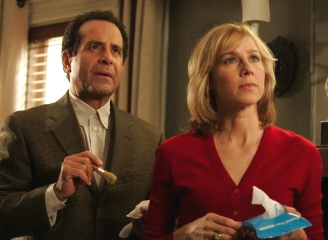
Natalie
and Disher |
In
fact, all of the main characters
take a path of growth in
this book. Part of this
may be that this book, when
compared to the other books,
seems to jump ahead in time
a bit. Julie is about 17
years old—her clear
voice reflects her age—and
this is the first book to
feature Dr. Bell. |
 Stottlemeyer
|
Though
the well-paced unraveling
of the plot and the steady
tone make the entire layout
pleasing to read, it is
the way the main characters
and, maybe more importantly,
the secondary characters
jump off the page that make
this Monk book most enjoyable. |
Stottlemeyer
is particularly complex,
the entire story is anchored
around him, and never does
his believability suffer
because of it. Disher takes
an unusually large role.
So large, in fact, that
the standard Natalie first
person narrative changes
at times for the telling
of Disher’s part of
the story. |
In
Dirty Cop, Monk
is the best he has ever
been. His obsessions are
ridiculous yet maintain
great continuity, a formula
that nearly convinces the
reader that the obsessions
are not so illogical after
all. Monk is also outright
hilarious—more so
than ever. His often painfully
humorous and equally serious
relationship with Stottlemeyer
is golden; Monk admires
him greatly but still manages
to be completely clueless
to Stottlemeyer’s
feelings, yet Stottlemeyer
never loses faith in Monk.
It is a pleasure to read. |
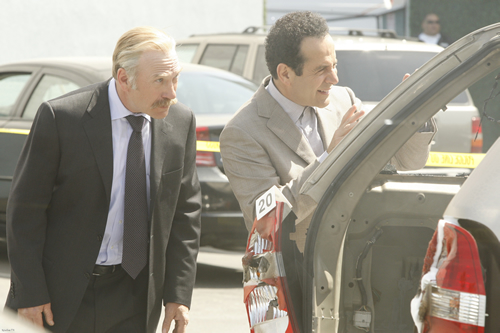
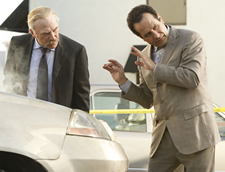 Stottlemeyer
and Monk
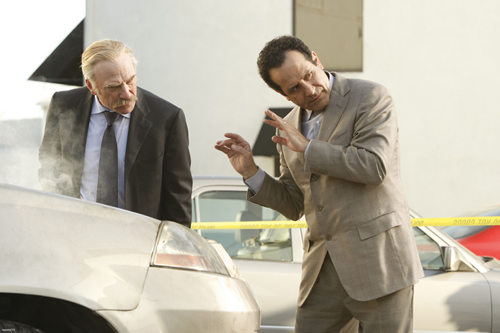
Stottlemeyer
and Monk |
Just
when the story should
be winding down, Goldberg
picks up the pace and
leads to an ending that
is neither rushed nor
lethargic. He uses Natalie
and her increased detecting
skills to give the reader
a chance to figure out
the case before it is
ultimately revealed. This
gives a unique perspective
and puts the reader in
a position to do some
thinking before the final
“here’s what
happened” takes
place.
|
|
This
book is packed with distinct
characters—like a
retired bartender—and
surging plots, but it never
feels crowded or strained.
Lee Goldberg does a lot
of storytelling without
sacrificing the details.
By not being over the top,
Mr. Monk and the Dirty Cop
finds a successful way of
being a refreshing addition
to the series. |
| This
is hands down the best book
yet. I am happy to have found
a new favorite in Mr.
Monk and the Dirty Cop. |

Monk Fun
Page Review:
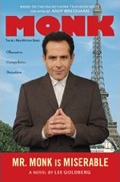
Mr. Monk is Miserable
by KC
 |
"There's
no better way to discover
Paris, its culture, and
its people than through
a murder investigation.
You'll see the city and
its people laid bare.
You'll go where the tourists
never go. You'll see what
life here is really like."
"It's
a shame everyone can't
enjoy a good murder when
they come to Paris."
"We're
the lucky ones,"
Monk said.
|
|
After
their trip to Germany, Monk and
Natalie head to Paris for a vacation.
A vacation is something Natalie
longs for. Her journey to Hawaii
was filled with murder, and then
the trip to Germany was ruined
by the same kinds of lethal activities.
But, as they say, the third time’s
the charm.
Lee
Goldberg’s Mr. Monk
is Miserable starts off where
Mr. Monk Goes to Germany
ends. Of course, Monk is not exactly
eager to visit Paris, but Natalie
does some manipulating and soon
they find their way to the iconic
European city.
|

Natalie
Teeger
|

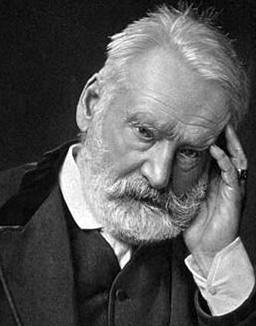
Victor Hugo |
As
the author explains in the acknowledgments
and notes, he has personal ties
to Paris and has spent time there
in the past twenty years. In his
vibrant descriptions, he takes time
to illustrate some changes that
have occurred in Paris over the
years, and if that is not enough,
there is a Victor Hugo quote about
the sewers of Paris. With Paris
as a back drop for a story that
slightly breaks the Monk novel formula,
readers will find great enjoyment
in this book. |
Adrian
Monk, despite his best efforts,
is becoming a well traveled man.
And Natalie Teeger, despite her
best efforts, can’t get a
vacation. And together they solve
some marvelous mysteries in places
far beyond San Francisco. While
in Paris, Natalie does everything
she can to keep Monk away from corpses.
Even when they stumble upon corpses,
she tries her best to keep Monk
away from the case. This becomes
exhausting for both of them, and
eventually they are in full crime
solving mode. |
Just
because Monk and Natalie are far
from the San Francisco Police Department,
don’t think that this book
is absent of Stottlemeyer and Disher.
They play a big role in making the
book down right hilarious. Goldberg
has Stottlemeyer down perfectly—some
of the best scenes are with the
Captain front and center. Disher,
though, has a star making performance—Paris
may be his city. With Stottlemeyer,
Disher, and a few dead bodies, Monk
gradually warms to Paris and even
has some good, clean fun. |
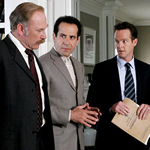
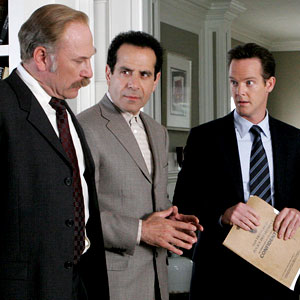
Stottlemeyer,
Monk and Disher |
In
the midst of his fun, Monk takes
great risks. He visits a sewer,
the catacombs, and a completely
dark restaurant. The pitch-black
restaurant scene was a personal
favorite. It made me want to find
a restaurant where the dining room
is intentionally pitch-black. |

Paris
|
Because of vividly written scenes
like the dark dining room scene,
this is perhaps the best written
Monk novel. The author takes what
feels like classic murder mystery
ideas and turns them into something
more complex and engaging with every
page. Not only is the mystery portion
well paced, but it is also a way
to help the reader discover a Paris
less romantic and more dynamic than
the average tourist might experience.
|
Goldberg
describes Paris with great care
and treats the city as a central
character. And Paris, as a character,
can be charming, funny, eccentric,
and a little menacing. Paris also
teaches us quite a bit about Natalie.
We learn more about Natalie’s
relationship with her late husband,
Mitch, and why, out of all of the
great European cities they could
have gone, she chose Paris. We also
learn more about Monk and Natalie’s
relationship. |
|
They, rightfully so, do not have
a perfect relationship. There are
times when they don’t seem
to want to be in the same room together
(sometimes quite literally), and
there are other times where they
would be lost without the other.
For the two of them, this is a story
of compromise. When not detecting,
they are constantly working to find
a middle ground, a place where they
can be themselves. |
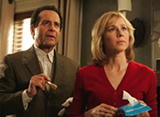
Monk and Natalie |
| The
more difficulties they encounter,
the more they are required to overcome.
This makes them both believable
and vital. Even when frustrated
with one another, they have moments
where they quietly enjoy each other’s
company. |
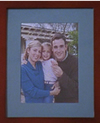
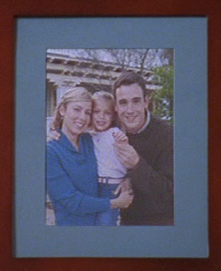
Natalie, Julie
and Mitch |
Mr.
Monk Goes to Germany deals
greatly with Trudy’s murder;
in contrast, Mr. Monk is Miserable
touches on Mitch. In both books,
the reminder of their respective
spouses sends both Monk and Natalie
running through foreign streets,
literally. Monk takes off running
in Germany, and Natalie does the
same in Paris. Between the two of
them, there is a lot of heartache,
and without directly discussing
much of it to each other, they always
seem to be acutely aware of what
they share. |
The only
big complaint about this addition
to the Monk series is that Julie
was once again absent from the
book. With Natalie as the narrator,
it would seem logical to have
her only daughter as a more central
character. Perhaps Natalie will
get a true vacation if she takes
Julie with her. Maybe.
Mr.
Monk is Miserable is a finely
tuned mystery that encompasses
everything we have come to love
about the TV series, and sometimes
it manages to give us much more.
By Lee
Goldberg
Penguin/Putnam/NAL
288 Pages
ISBN 0451225155
Price: $21.95
Release Date: December 2nd, 2008
Hardback
Edition
Paperback
Edition
Audiobook
Kindle
Edition
|
Monk
Fun Page Review:
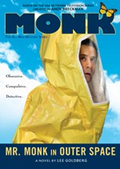
Mr. Monk in Outer Space
by KC
“'Who
wants to watch a clean freak every
week? It would be too damn irritating.
So we worked on it over the lunch
and came up with something a lot
better—a detective who is
a sex addict. Can you see it?'”
|
|
|
Who would
want to watch a clean freak on
television every week? Better
yet, who would want to read a
book, multiple books, about a
clean freak who we already watch
on television every week? Take
your time answering that.
Television
is still a powerful entertainment
tool in our society. Perhaps,
since you are reading this review,
you know the kind of power it
has. In Mr. Monk in Outer
Space, Lee Goldberg takes
a kind-hearted jab at fandom and
its absurdity and magnitude.
|
|
Monk enters into a world where people
are as obsessed with a TV show as
he is by order and cleanliness.
He does not understand why anyone
would spend so much time caring
about a fictional place with fictional
people and events. But when Monk
learns that his brother, Ambrose,
is one of “them,” it
throws Monk for a loop—as
does a revolving door, a microscopic
coffee stain, the way Natalie organizes
her thoughts and more. But at the
center of it all, there is, of course,
a murder. Murder is the only thing
that keeps Monk halfway sane while
dealing with Ambrose’s obsession
with the TV show, Beyond Earth,
and the other “freaks”
that love the show. And as Monk
wearily admits, “'It would
take dozens of murders a week for
me to feel really good about life.'” |
So much
of the entertainment in this addition
to the Monk book series is the
fact that it could make some Monk
fans either cringe or put them
in a state of denial. You, for
instance, may cringe because you
see some of yourself in the Beyond
Earth fans, or you will deny,
obsessively so, the fact that
you are even remotely like the
Beyond Earth fans Goldberg
depicts.
Let’s
take a test: be honest, be fair,
and do not print out this test
because it would be a horrible
waste of paper. Just keep track
of how many YES and NO answers
you have.
|
|
|

Marci Maven,
Mr. Monk's biggest fan, except for
those of you who ace this test
|
1. Have you seen every Monk
episode?
2. Do you own all the available
seasons on DVD?
3. Do you have all of the Monk
books?
4. Have you read these Fun Page
reviews more than once?
5. Is your house cleaner than it
was before you started watching
Monk?
6. Is brown a predominate color
in your wardrobe?
7. Do you have an assistant and
call him/her Natalie?
8. Do you own a Monk bobblehead
doll?
9. Have you been to a Monk
fan convention?
|
10. Are
you happy this list ends with
10 questions?
Congratulations!
You are done. If you answered
5 or more YES, than you will relate
to the Beyond Earth fans
in this book and will cringe at
the appropriate parts. If you
answered less than 5 YES, you
are probably in denial that this
book depicts the kind of fan you
could be. If you answered all
of them YES (and number 9 was
definently among them) than you
will not cringe because you find
the obsessed characters in the
book to be your kind of people,
and you will take tips from Outer
Space and implement them
into your next Monk themed
party.
Now that
you have scientific data about
how well this book will relate
to you, the Mr. Monk in Outer
Space review will try its
best to continue.
|
|
Aside
from the murders and the TV show
fans, there is Ambrose. Monk has
always been distant from his brother,
but when Monk is forced to temporarily
live with Ambrose, Monk has to try
to become more accepting of his
brother. Their relationship, for
the duration of this book, goes
through a small, nearly undetectable,
evolution. There are moments when
their relationship seems to begin
exploration, but it quickly drops
off in place of the mystery at the
center of the plot. That is acceptable,
though, because Ambrose is a driving
force behind the mystery of the
story, but there is something missing
with the sub-plot of their relationship. |
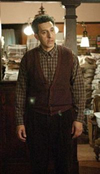
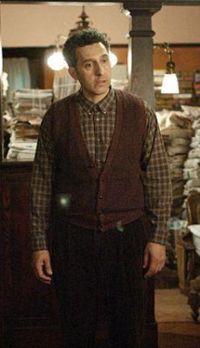
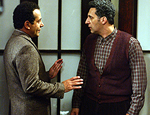
John Turturro
(Ambrose) |
 |
Though
it is completely in character for
the Monk brothers to be distant
and have difficulty communicating
with each other (as is shown when
Natalie has to become their “surrogate
hugger” because Monk and Ambrose
cannot hug each other), this story
seems to introduce their relationship
only to neglect it. The story line
of Ambrose starts off well and looks
promising, but |
never fully concludes—it just
stops. The reader is only aware
of it stopping because the pages
have run out. |
On
the bright side, the mystery is
fun and engaging. Also, Disher and
Stottlemeyer play solid roles throughout.
But it is Natalie who does the heavy
lifting and really makes the nearly
unbelievable and unsympathetic Monk
the hero we root for. It is also
Natalie who pulls the story of Monk
and Ambrose through the book. Her
observations are key. |
 |
Mr.
Monk in Outer Space will
leave you wondering about your
own obsessions of a certain TV
show, and it may, hopefully, leave
you wondering how your brothers
or sisters are doing.
So get
away from the computer, turn off
the TV, ignore text messages,
and call your brothers or sisters—better
yet, go visit them. More than
likely, the longest relationships
we will ever have are those with
our siblings.
|
  Mr.
Snork Fans?
Mr.
Snork Fans? |
Monk
Fun Page Review:
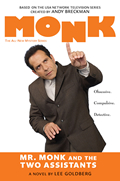
Mr. Monk and the Two Assistants
At
first, I felt like an actress brought
into replace a beloved character
on a hit TV show, For months, it
seemed as if I was constantly being
compared by Monk, and everyone else
in his life, to Sharona, and falling
short. — Natalie Teeger
in Mr. Monk and the Two Assistants
|
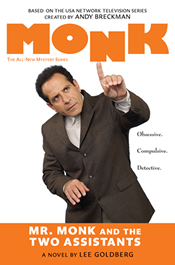 |
Mr.
Monk and the Two Assistants
is the first Monk novel to debut
(July 3rd 2007) in a hardback edition.
That means you'll have to pay twice
as much for this one as you did
for the other three. Well, you're
just going to have to suck it up,
because it's worth every penny.
Two assistants mean twice the fun
and twice the mystery and twice
the passion.
"Sharona
and I had this erotic tension between
us," Disher said standing in
the doorway. "A hot 'will they/won't
they' thing."
"More
like a 'will never happen' thing,"
Stottlemeyer said.
"It
was palpable," Disher said. |
Sharona
is back in all her brassy glory
and Natalie is none too pleased
when Monk welcomes his first assistant
with a job offer. Natalie thinks
the best way to ensure her own job
security is to reunite Sharona with
her soon to be ex again husband.
The problem is he's been arrested
for murder and even Sharona thinks
he did it. And it gets a lot more
complicated. There are enough twists
and turns to keep Monk fans on the
edge of their seats (as long as
those seats are on even numbered
rows.) |
 |
| |
I
wasn't one of them, but many fans
were a little put out by the way
the character of Sharona was written
out of the series, as necessitated
by Bitty Shram's abrupt departure
in the middle of the third season.
Since the author doesn't have to
deal with the actress, he's able
to write her exit (in retrospect)
and her return with all the careful
elucidation and emotional authenticity
all but the most die hard Sharona
fan could have desired. Having written
"Mr. Monk Goes to Mexico"
(recently chosen as the fans' favorite
episode) and "Mr. Monk and
the Godfather" I think Mr.
Goldberg really gets Sharona. |
Since
we're now on the fourth novel you
might expect the plots and characters
to begin to blur a little, but the
opposite is true. Each book is delightfully
unique. Maybe it's just me, but
I see more depth and substance in
this novel, than in the first three,
which were all solidly entertaining
in their own right. The exploration
of the two relationships between
Monk and his assistants is fascinating.
The novel touches on the similarities,
the differences, the humor and the
evolution of both relationships.
Great stuff. The obstacles are obvious
and I'm not sure how it would ever
come about, but it would be so cool,
and ridiculously easy to promote,
if Two Assistants was turned
into a TV episode. |
 |
 |
There's
also something warm and familiar
about this one, besides Natalie's
narrative voice. I've often taken
that drive down the five she so
piquantly describes. I've been on
Baker Beach (and thought what a
great place that would be for Monk
to solve a murder). I've been to
book signings eerily like the one
described in the book. Oh, that’s
right: it was a Lee Goldberg book
signing. |
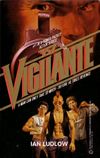
An
interesting sidenote: Ian Ludlow,
a novelist, Monk's L.A. counterpart
and Disher's idol (he refers to
him as "the Tolstoy of the
mean streets") was also Lee
Goldberg's early pen name when he
was writing classics like .357 Vigilante.
I think knowing that gives the reader
a greater insight... into what I'm
not sure.
My
favorite scene? Sharona and Natalie
interrogating the woman with the,
shall we say, unusual brooch. Hysterical.
It's
a good thing it's in hardback. It
will stand up better to all the
re-reading. |
 |
Goldberg,
Lee. Mr.
Monk and the Two Assistants. New York:
Penguin Group, July 2007. 288 pages. $19.95
Monk Fun
Page Review:
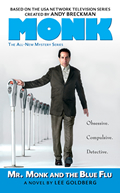
Mr. Monk and the Blue Flu
“What
about the criminals?" Monk asked.
"Are they going to take a sick day
too?”
| |
The
Monk books just keep getting
better. Better than the TV series?
I won’t fully commit to that,
but the novels have what the show
sometimes isn't even aiming for:
well executed fair play whodunit
mystery plots. The complex story,
abundance of colorful characters
and high body count in Blue
Flu may demand a little more
concentration than the show or even
the previous two books. It’s
too delightfully long and complex
for an episode, but trimmed down
it would make a great entry in the
series, just as the first novel
(Mr. Monk and the Firehouse)
did when it was adapted for the
fifth season episode “Mr.
Monk Can’t See a Thing.” |
Just
to get this out of the way, the
more Monk-ish Monk fans
can now rest easy. Monk’s
milk phobia, established in the
series, was overlooked (by the author,
by the creator, by me, but not by
legions of persnickety squared readers)
in the first and second books. The
“milk error” has been
corrected in Blue Flu.
Not only that, but we’re given
a little more insight into Monk’s
rationale for the phobia: |
|
| “He’s
afraid of milk,” Porter said
to Sparrow.
“You
are?” she said, momentarily
showing interest in something besides
looking uninterested. “Why?”
“It’s
a bodily fluid in a glass that some
twisted person intends to drink.”
Monk cringed just thinking about
it. “It’s unnatural.” |
| |
Natalie
is like an old friend now, telling
me her experiences over a cup of
coffee. I know the books (and the
blogs, also initially ghost written
by Lee Goldberg) have done more
than a little to shape my favorable
impression of her on the show. Having
her as a guide in Monkland
is just plain fun. She’s always
a little mystified and frustrated,
but loyal and true just like the
literary figure to whom she draws
her own comparison: “I
went with him, even though I wasn’t
a cop and hadn’t been invited.
I’m pretty sure that Dr. Watson
would have gone with Holmes in the
same situation.” |
Also
notable is Natalie’s impromptu
art lecture. It’s a must read
and a high point in Monk noveldom.
“A box of Brillo soap
pads is just a disposable consumer
product in colorful packaging. But
when Andy Warhol made exact plywood
replicas of the Brillo boxes and
stacked them in a gallery they became
art.” – Excerpt
from Professor Natalie’s Lecture
somewhere around page 128. |
|
| 
|
Monk
himself is a little more chatty
here and, I think, a little less
self aware than the TV version.
It may be mostly Natalie’s
perspective that makes him seem
a little more self-centered, demanding
and stubborn. Those are all traits
he has in the show, but they’re
not softened as much without Tony
Shalhoub’s performance and
a third person perspective. On the
other hand as Acting Captain we
get to see a few new facets of the
Monk character, some genuinely hilarious
interactions with his new subordinates
and a little more exploration of
his friendship with Stottlemeyer. |
Adrian
Monk in the novels may be a slightly
different character, but Lee Goldberg
has got Leland Stottlemeyer completely
nailed. I can almost hear Ted
Levine say every line. His relationships
with Monk, Natalie and Disher
are perfectly in sync with the
character as developed by Levine
and the writing staff (including,
of course, the three scripts Goldberg
co-wrote in which the Stottlemeyer
character got some first rate
development.) I like that we get
to see Stottlemeyer dealing with
his divorce in more detail and
I think he comes off as particularly
caring and compassionate about
Monk in Natalie's eyes.
|

“That’s
quite a list,” Disher said.
“I could use a hand.”
“Get
all the help you need”
“What will you be doing?”
Disher asked pointedly.
“Captain stuff,” Stottlemeyer
said, his eyes daring Disher to
push it beyond that.
|
Once
again Disher gets short shrift,
but that's the way it goes in the
series as well, so no big surprise.
He wriggles into a few scenes, but
no major heroics or imaginary girlfriends
or dental appointments. He isn’t
actually there to hear it, but there
is a very nice bit about him from
Stottlemeyer: “The cases he
solves aren’t unusual, high-profile,
or particularly colorful. But, by
God, he closes them.”
A
cast of colorful guest characters,
the reinstated detectives and their
companions, fill out the rest of
the book.
Det.
Cindy Chow is a paranoid schizophrenic
accompanied by her psychiatric nurse
doing a doctoral thesis on the
commonality of certain facets of
complex, recurring conspiratorial
delusions which form an almost Jungian
shared unconscious.... you
get the idea. He doesn’t seem
to be helping her much:
“You
can drop the charade,” Chow
said. “I know you both work
for them.”
“Them?” Monk said.
“The extraterrestrials occupying
the shadow government,” she
said. |
 |
"Mad
Jack" Wyatt is the second
coming of Dirty Harry or at least
thinks he is. “I’m
back in the game and my gun has
bullets,” He announces,
cleverly working the title of
a previous Lee Goldberg novel
into his would be catch phrase.
He has his own personal anger
management counselor in tow who
says things like: “Don’t
let your anger drive you. Drive
your anger. Steer it to the garage
and park it.”
|
He
and Monk hit it off right away.
“I
was born to take scum off the street”
“So
was I,” Monk said. “Which
cleanser do you prefer?”
Wyatt
opened his jacket to show Monk the
gigantic gun in his gigantic holster.
“Three fifty seven Magnum.
You?”
“Simple
Green,” Monk said.
|
|
Frank
Porter is a once brilliant detective
now suffering from senility and
tagging along with him is his twenty
something granddaughter, Sparrow.
She takes care of him, “Because
it beats slinging burgers at McDonalds.”
Frank’s
memory isn’t what it used
to be.
“What
day is it?” Porter asked.
“Sunday,” Sparrow said.
“That’s good to know,”
Porter said. “What year?”
“2007,” Sparrow said.
“No really,” Porter
said. “What year?”
“2007,” Sparrow said.
“That’s not possible,"
Porter said. “I’ll be
dead by then and there will be Holiday
Inns on the moon.”
Toss
in a few murderers and half dozen
or so murder victims for a super
fun concoction. |
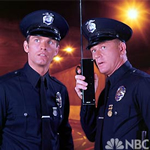 |
Blue
Flu has so many nice touches that
you’ll just have to read the
book to enjoy them all, but I’ll
just mention my favorite. At the
first murder scene Monk and Natalie
meet a uniformed cop. “His
name was Milner and if not for the
wedding ring he was wearing I might
have been interested in his first
name too,” says Natalie.
That first name turns out to be
very interesting. He’s Officer
Kent Milner. Get it. Kent McCord,
Martin Milner, Adam-12, Officers
Reed and Malloy. Well, I thought
it was very cool. |
In
fact the whole book was cool, exciting,
funny and the perfect remedy for
the fan who has two more weeks before
Monk episodes resume on USA.
Buy
it at Amazon!
By Lee
Goldberg
Penguin/Putnam/NAL
304 Pages
ISBN 0451220137
Price: $6.99
Release Date: Janurary 2nd, 2007 |
Monk Fun
Page Review:
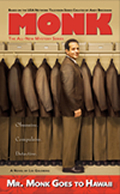
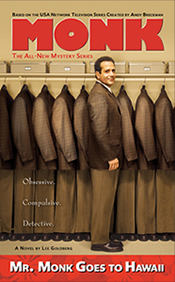
Mr. Monk Goes to Hawaii
 |
Sung
to the tune of the theme from
Hawaii Five-0 —
If you
get in trouble, call the Monk, that's
me.
If you find a dead body, I'm the
guy to see-eee
Stop! In the name of the law.
Stop! Murder sticks in my craw.
I'll find the killer. Call the Monk
that's me....
Mr.
Monk Goes to Hawaii is
filled with inspired goofiness,
rich characterizations, an intricate
mystery and a lot of fun. You probably
won't want to put it down until
it's over and that's way too soon.
Unwilling
to stay home alone, Monk tags along
on Natalie's vacation, with a little
help from Dr. Kroger's magic "Dioxynl"
pills, which make the long flight
tolerable for Monk and intolerable
for Natalie.
|
| "Everything
should be dry-roasted," he proclaimed
to one and all. "Has anybody
ever tried dry-roasted chicken? Or
dry-roasted granola? The possibilities
are limitless!" |
| I
thought the flight would never end.
(Natalie
doesn't realize how lucky she is
that no one was actually murdered
on the plane.)
Once
the effects of the medication have
worn off Monk discovers that Hawaii
is not his idea of paradise and
Natalie learns that a vacation with
Monk is no vacation. Quicker than
you can say Prince of Darkness,
Monk spoils a wedding and a fellow
hotel guest falls victim to the
Monk curse. ("Stop calling
me the Prince of Darkness. That's
how rumors get started.") Even
though the local police have concluded
she was accidentally killed by a
falling coconut, Monk knows she
was murdered. All the clues and
a TV psychic point to her philandering
young husband, but Monk realizes
there's more to it.
Mr.
Monk Goes to Hawaii is the
second Monk novel by Lee Goldberg.
This one is also told from the perspective
of Monk's assistant Natalie Teeger.
In fact the author has settled so
comfortably into her voice you almost
expect to see her name on the cover.
This is the kinder, gentler Natalie
she's grown to be on the show. This
is the Natalie I'd like to spend
more time with: funny, strong, loving
and vulnerable.
In
Mr. Monk Goes to the Firehouse
having the story told from her viewpoint
created a bit of a barrier between
Monk and the reader, which required
some adjustment from long time Monk
fans. However, in this novel, by
removing them from their natural
habitat we get a deeper exploration
of their relationship and a better
understanding of Adrian Monk through
Natalie's eyes.
The change of scenery also means
that the novel is virtually SFPD
free. On Kauai, the character of
Lt. Ben Kealoha fills the gap left
by Stottlemeyer and Disher. This
isn't the first time Lt. Kealoha
has dealt with a crazy haole [foreigner].
He was introduced in the Diagnosis
Murder novel The Death Merchant
by Lee Goldberg, where Dr. Mark
Sloan takes a Hawaiian vacation
with similarly predictable results.
"Almost
too great," Monk said. "I
never trust people with great alibis.
Or people who drink soda directly
from the can. Or people who pierce
any part of their bodies."
"I
have pierced ears," I said.
"So
do I," Kealoha said. ""Nipples,
too"
I'd
definitely like to know more about
Kealoha. Maybe he can visit Monk
in San Francisco one day.
On
my one and only visit to Hawaii
the luau was the only disappointing
part. It rained, so we had it indoors.
On the other hand, Monk and Natalie's
luau absolutely rocked, but I won't
spoil it for you by describing the
entree.
This
book marks the first time that Summit
NJ has been immortalized in literature.
At least I'm betting it's the first
time. The mention in the book is
a nod to the Monk writing
staff who toil in Summit rather
than in Los Angeles where most television
writers are found. Reportedly they
have a lot more fun.
|
|
|
It's
a solid mystery and I found the solution
particularly satisfying. No doubt
fans will catch a few errors, but
I didn't notice any.... except that
Monk and Natalie are flying out of
LAX and Monk's still eating cereal
(but I didn't notice any mention of
milk: he could be eating it dry.)
By and large though, it's very consistent
with the series and yet charmingly
enhanced by Natalie's voice.
Lee
Goldberg once said,"I want to
capture the feel of the series, but
also I want these books to stand on
their own. They’re original
novels. They’re not based on
episodes. So I want them to almost
read as if they’re the books
the TV series is based on." I
think that's what he's achieved with
Mr. Monk Goes to Hawaii.
Each
Monk season consists of only sixteen
episodes a year, which allows the
writers and cast to deliver consistent
quality, but a loyal fan is left wanting
more. A couple of Monk novels a year
sure helps. I'm not sure how that
equation will work if they keep making
episodes based on the novels (as with
the episode Mr. Monk Can't See a Thing
based on Mr. Monk Goes to the
Firehouse.) However, I'm pretty
sure they can't afford to film in
Hawaii.
The
novel ends with an excerpt from
Mr. Monk and the Blue Flu which
will be released early next year.
Looks like San Francisco has a new
fictional Mayor in Blue Flu and he
shares the last name of a favorite
actor of mine, Smitrovich. Bill
Smitrovich played Inspector Cramer
in A&E's
Nero Wolfe, for which Lee Goldberg
and William Rabkin wrote. Coincidence?
I'm thinking, not.
"Open
your eyes, woman. There are lizards
on the wall. This is a full-wipe situation."
— Adrian Monk
By
Lee Goldberg
Penguin/Putnam/NAL
294 Pages
ISBN 0451219007
Price: $6.99
Release Date: July 1, 2006 |
Monk
Fun Page Review:
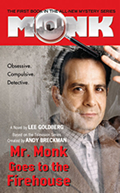
Mr. Monk Goes to the Firehouse
|
Most
insanely devoted Monk fans, and some
of the more casual viewers, will approach
Mr. Monk Goes to the Firehouse
with a little trepidation. How can
this new medium hope to capture the
essence of Monk the series and Monk
the character? The charm and success
of both seem inextricably tied to
the virtuoso (Emmy, SAG, Golden Globe
winning) performance of the show's
producer and star Tony Shalhoub. Author
Lee Goldberg's answer to that is to
dedicate the book To Tony Shalhoub,
the one and only Monk and to
take a step back from the title character.
Instead he tells the story from the
point of view of Adrian Monk's assistant,
Natalie Teeger and it turns out Natalie's
head is a nice place to be.
|
In
this novel, the first of at least
three, Monk's apartment is being fumigated
so he moves in with Natalie and her
12-year-old daughter Julie for a few
days. Julie's got a ready made mystery
for their houseguest: Sparky the firehouse
dog has been murdered. Monk agrees
to take the case, but the Dalmatian's
demise is just the tip of the garbage
heap. The mysteries pile up quickly,
but Monk eventually sorts them all
out.
The
Natalie persona is a comfortable host
in the tradition of Dr. Watson and
Archie Goodwin. Like her literary
predecessors, she's sufficiently mystified
by the puzzles Monk solves; she tackles
the romantic subplot with warmth and
humor; and she does most of the heavy
lifting. Her encounter with the mugger
is inspirational.
The humor throughout is very Monk,
just a little off center and never
too jokey: "He's a dog, she's
a dog, I think that's all that really
matters to dogs," I said. "That's
why they call them dogs."
The
characterizations of Natalie, Captain
Stottlemeyer and Julie are all spot
on. Lt. Disher only shines briefly,
but that's how it usually is for him
on the series as well. All the new
characters are very vivid. So much
so that it's almost as easy to visualize
them as the characters we already
know. One of my favorites is the Fire
Chief, Captain Mantooth. Unless I'm
wrong, which I don't think I am, that's
a nod to Firefighter/Paramedic Johnny
Gage, played by Randy Mantooth on
the classic TV series Emergency. I
hope when and if the novel becomes
an episode that Randy's available
for the part. Pop culture references
abound and that's part of what makes
the book just plain fun to read.
The
plotting is well done, intricate and
exciting, but the novel also has the
one element that defines the series,
heart. It's what makes the character
of Adrian Monk admirable instead of
laughable and what makes all the relationships
ring true. Early on Natalie and Stottlemeyer
have a brief conversation:
"How
are you holding up with Monk as a
houseguest," Stottlemeyer asked
me.
"It's
only been a few hours."
"A
few hours with Monk can seem like
decades," he said. He took a
pen from his pocket, scrawled something
on the back of a business card and
handed it to me. "This is my
home number. If you need a break,
give me a call. I can take him out
to the car wash."
"Thank
you, Captain," I said. "That's
very nice of you."
"You
and I are the only ones who take care
of him. We have to back each other
up."
"We're
sort of like partners."
"Sort
of," Stottlemeyer said.
"He
likes the car wash?"
"Loves
it," Stottlemeyer said.
Perfect.
From that point on I didn't put the
book down.
I
cheered at the ending of the main
mystery and loved the final chapter
with the revelation of a secondary
mystery.
Monk
fans will no doubt spot a few continuity
errors. Most noticably, as revealed
in the series, Monk doesn't drink
milk and although he never actually
gets around to it here, it's discussed
as if he does. I was also suprised
that Monk was allergic to cats. In
"Mr. Monk and the Missing Granny"
it was established that Disher was
allergic to cats, but there was no
indication that Monk was and in that
particular episode he's exposed to
the same cat that Disher is.
As
a result of a surprising development
on the show, Natalie goes from saying
she pushes a cart around Wal-Mart
in the beginning of the novel to admitting
she grew up with money and it feels
like a bit of a u-turn even if it
was unavoidable.
Also
at the beginning some readers may
already identify more strongly with
Monk than Natalie does, but the bond
between the characters seems to get
stronger as the plot progresses. We
finally get a deeper look at Monk
from Natalie's perspective when he
confides in her about what drives
him: "There's nothing magical
or spiritual about it. I'm not skilled
enough yet to figure out who murdered
my wife. If I solve enough cases,
maybe someday I will be." |
|
Even
with a couple of minor flaws that won't
get by most Monk fans, Mr. Monk Goes
to the Firehouse is just what Monk
should be. Goldberg has a clever, breezy
style that matches the tone of the series.
Even the hard to please devoted fans of
the TV series shouldn't be disappointed
and with only sixteen episodes a year supplemental
Monk is a blessing.
Author
Lee Goldberg is the mystery writing's answer
to Pierce Brosnan. Brash, yet sensitive;
jaded, yet optimistic, he's toiled in the
Hollywood trenches for decades as a screenwriter
and producer on such cultured fare as Diagnosis
Murder, Nero Wolfe, Deadly Games, Flipper,
Baywatch and, of course, not just one,
but two
episodes of Monk. He has a couple of Edgar
Award Nominations and a notorious
blog. He doesn't brag about it, but
he writes like a girl: "My wife is
amazed I was able to capture a woman's voice,
too" admits Goldberg. "If I understand
women so well, she says, why don't I understand
her!" (Probably the same reason Adrian
Monk can't solve his wife's murder: he's
just too close to it.) Lee is also the man
behind the woman for Natalie's
blogs on the USA
Network Monk Site.
Goldberg,
Lee. Mr.
Monk Goes to the Firehouse. New York:
Signet, 2006. 292 pages. $6.99
|
  
|
|
|
|
|