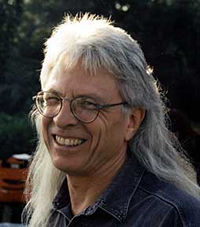
|
Terry: Oh, we loved it.
Paula:
I mean there were things about it that we
really liked including the scene where Monk
is talking to that guy in the hospital.
That was a really great dramatic moment.
So if the viewers didn't watch through until
the end of the show I feel bad, because
that was a really good moment there.
MFP:
That's a classic Monk moment. That's one
of the moments that define the rest of the
series.
Terry:
What I found interesting while visiting
the set, interviewing and just observing
the workers on the show, everyone involved
really loved the show. I mean the make-up
and hair and camera and the sound and set
decoration people, they just don’t
go to work every day and do their job; they
go to work every day and enjoy doing their
best. Everybody that I met there is so proud
of working on Monk. They all just know that
they have a gem in their hands and they
want to keep it polished. It was impressive
how every employee that I talked to almost
feels honored to be working on this show.
They know that they would be employed in
the television business because they work
all the time, but this is a show that everybody
is really proud to have on their resume
and the quality of their work shows it.
They go to work to do a good job, not just
to go to work.
MFP:
Do you think there’s any less turnover
on Monk with the crew as a result?
Terry:
No, there’s a lot of turnover for
a couple of reasons. If you get hired on
a normal network show, you’re probably
going to have 23 episodes a season, but
Monk only has 16 episodes a season.
Paula:
And they don’t shoot them all the
way through the way a regular T.V. show
does. They have the hiatus in the middle.
Terry:
Right. You know, they shoot nine and then
they shoot seven, however it works. So people
can’t afford to have all that time
off. So during the hiatus period they’ll
get hired on to other shows and they disappear.
So Monk has to fill the jobs of the people
who went away simply so that they could
pay their rent. The fact that there are
only 16 episodes a season keeps the show
fresh and fun, but the downside is that
the employees sometimes have to go find
another job. You know, you’re not
just talking about rich people here; everybody’s
a worker. We all know about keeping that
paycheck coming in. So there’s a pretty
big turnover on Monk, not because people
leave the show, but because the show shuts
down and they go off and find continuing
employment. So it’s a two edged sword
that way.
MFP:
So did you learn anything that really surprised
you about the show?
Terry:
Surprised us about the show? I think the
fact that none of the writer’s had
ever done television before. I mean they
had worked on T.V. they had written skits
for Saturday Night Live….
Paula.
They’re comedy writers.
Terry:
Yeah, they’re all comedy writers.
They all come from the stand-up comic world.
Previously they were more comfortable in
comedy clubs then they were in a T.V. studio.
Paula:
Or writing like say David Letterman or for
Saturday Night Live or something like that.
You know, writing shtick for the person
to say on stage.
Terry:
You know, even though the show is shot in
Los Angeles, the writing staff works in
New Jersey and they’re 3,000 miles
away. So I went to New Jersey for ten days
and sat with the writing staff and watched
them go through some episodes. I watched
them do the entire episode, “Mr. Monk
Gets Jury Duty.” It’s absolutely
evident, even though this was the end of
season four, that they’re still writing
comedy skits rather than T.V. scripts. I’ve
sat in on what they call story sessions
on many different television shows and they
will put down a list of plot lines. The
clues are going to happen here and the murder
is going to happen here. And it’s
very serious sometimes. But in the Monk
writing room, while they were going through
the same thing, they figured out the plot
line as they went along and they put down
the clues. They’ll do this and the
murder will happen here. At the same time
the writers were telling jokes all the time.
You would think nothing would get done because
it was almost like just a fun joke telling
session. So everybody was always laughing.
That impressed me, how talented these guys
are. We tried to mention this in a couple
places in the book, where a large number
of really wonderful jokes were told and
then just disappeared, not written down.
They just said, “Oh, that won’t
work for the episode” and they just
disappeared into the air and no one else
will ever hear them. Because these are really
talented comedians who are writing the show
and they’re more comedians than they
are not.
Paula:
So it’s kind of amazing that the show
also has that really strong dramatic element
too, considering they mostly come out of
a comedy background, but it has a real good
core of humanity. But Andy Breckman has
written movies and things like that he just
never wrote television before, so it could
be Andy’s story sense that holds the
whole thing together.
Terry:
But as several of the writers said, several
places, we repeat it I think in the book,
when they first started writing the show
they didn’t know what the structure
of a one hour television drama is and they
literally would telephone people and say.
“How many acts are we supposed to
have?” Because they didn’t know.
Where on many shows everybody knows already,
because they’ve taken screenwriting
classes, they’ve maybe gone to film
school. These guys came out of the comedy
world and it’s a totally different
kind of background and it’s one of
the things that make the show really unique.
MFP:
It makes it fresh and they’re not
in the same rut as all the other television
shows.
Terry:
Yeah, I think you’re right. It makes
it fresh and it doesn’t feel like
a show that’s in any kind of a rut.
MFP:
So what was the most difficult part of writing
the book?
Terry:
Transcribing. The most difficult part is
transcribing. The most difficult part of
the book I think was a number of things.
First of all, when I first went to the set
the people on the stage, all of the workers
from the cast on through all of the support
team, suddenly there was a stranger walking
on the stage with a questionable position.
You know, I’m not part of the camera
department I’m not part of the wardrobe
department, I’m just this guy. So
I had to go in and introduce myself and
kind of become friends with people and I
thought that would be hard. I thought that
I would be looked upon as maybe suspect.
You know, you can’t quite trust the
press sometimes because there’s gossip
and you want to be careful what people say.
I was surprised, it only took maybe a half
a day and I had friends and people even
invited me to have lunch with them. That
wasn’t difficult. It went away immediately.
So I was very impressed with how readily
I was accepted, walking on to the set as
a stranger.
Setting
up the original interviews I thought would
be a little bit hard, but Tony Shalhoub
has an assistant whose name is Doug Nabors
and I asked him, “Do you think I can
get some interviews with the actors within
the next ten days?” He said, “I
think so.” And he went away and about
a half an hour later he came to me and said,
“Jason Gray-Stanford is sitting in
his trailer right now with about three hours.
If you want to go interview him go right
now he’s waiting for you.” And
he said, “When you finish with Jason
go straight over to Ted Levine,” who
plays Stottlemeyer, “because Ted knows
you’re here and he’ll have a
little more time than Jason. So just go
straight from Jason to Ted and talk to him.”
This was within half an hour after I first
requested it. Then when I finished talking
to the two of them, you know, I went and
sat in their trailers with my tape recorder,
and I said “Um, how about Tony?”
Traylor Howard wasn’t there that day.
So I couldn’t ask for her that same
day, but I said, “How ‘bout
Tony?” and Doug said, “Tomorrow
at noon. He’ll have a couple of hours
at noon. You can go see him.” So I
was only there for one day. I asked one
question about whether or not I could speak
with the actors and within a half an hour
I had two of them set up and 24 hours later
I would finish with Tony. I had interviewed
all three of them. The next day Traylor
came to work and I approached her myself.
I said, “Hi I’m Terry, I’m
working on this book. Can we get together?”
She said, “Yeah, when I finish shooting
this scene lets go to my trailer.”
And we did. So within 36 hours after I first
posed the question for interviews I had
accomplished big interviews with all four
of the lead actors. That’s how friendly
and accepting they were.
Paula:
Oh, and by the way Doug Nabor’s has
moved up from being Tony’s assistant.
He’s one of the producers.
Terry:
Co-producer.
Paula:
Uh, not a co-producer. I think he’s
like an associate producer. Whatever it
says in the end credits on the show.
Terry:
He moved up into the production staff now.
So everybody was that cooperative and that
friendly. So that’s another thing
that I thought would be difficult and because
sometimes actors don’t want to give
up their time. You know they’re in
character. They don’t want to, but
it was very, very simple.
MFP:
Is it hard to get actors to talk about themselves?
Terry:
Sometimes it’s hard to get people
to talk about themselves. It isn’t
because they don’t want to. One of
the reasons people become actors is they’re
real good at being a different character;
they’re not so good at being themselves.
So sometimes an actor who can be the most
brilliant playing lots of different kinds
of people, he can be an Indian or a restoration
person or a man can play a female, you know
that sort of thing, and yet talking about
themselves, being who they are is really
difficult for them. So they just aren’t
good interviews.
Paula:
Some people are kind of instinctual actors.
When you ask them what it’s like to
do something they can’t really tell
you. They just kind of get out there and
they do it and they’re great and you
really like watching them, but they can’t
tell you what went into that performance
at all.
Terry:
They have no description of their technique
because it’s so natural to them. So
sometimes actors are, they’re not
difficult interviews, because they don’t
want to do it, just that tape recorder is
so foreign to them. They’re better
in front of a camera or on a stage.
So
the hardest part was including the second
half of season four in the book. I had to
telephone the actors at home and they gave
me contact telephone numbers which they
wouldn’t have had to do. The editors
would finish doing a rough cut version of
an episode and would make arrangements for
us to see it. We couldn’t watch it
on T.V. because it wasn’t going to
be broadcast for six months. They had to
make arrangements for us to get some place
where we could look at it. So there was
some coordination among a number of people
in order to accommodate our need. And everybody
just did it. They just did it right away.
It was surprising how we were causing them
additional stress and effort and everybody
just did it. There was never a complaint.
The telephone would ring. Randy Zisk is
the producer of the show. Randy’s
assistant would call me and say, “You
can see episode 12 now.” We were on
the list of people to be called even though
we weren’t really involved with the
show. So that was very impressive. So what
could have been impossible was hard, but
was done with a minimum of effort and really
didn’t cause us much stress except
for the time.
Paula:
And Andy really wanted the book to happen.
So Andy always would call around if he thought
there was going to be anybody not happy
about something. He would call ahead, kind
of clear the way and say, “Hey let’s
really make this a good book. We want this
to happen.”
MFP:
Was there anything in particular that you
had to leave out of the book that you wish
had stayed in?
Paula:
Nah, I think it was just a matter of space.
Terry:
Yeah, it’s just a matter of space.
Probably a lot of the stories that we tell
if you extended them a little bit more would
start to get boring. You know, a little
punchy thing is more entertainment then
a long drawn out thing. So even though we
have more interview information from the
writers and film makers, we probably picked
out the best of it.
Paula:
Yeah, we cherry picked it. If you were going
to try and write another book out of what
we had left, it probably would be all that
interesting. It’s just kind of extra
detail.
Terry:
There were several times I would put in
some little fact that Paula would say, “That’s
not as important as this one.” So
once again we would go through the list
and cross off things and say it’s
more important for them to know that they
shot in the country then to know it was
a dirt road instead of a freeway. You know,
we were careful with that sort of thing.
We tried to put the most entertaining stuff
in the book.
MFP:
What do you think makes Monk a great show?
Terry:
What makes Monk a great show? Well, four
things: the characters are great, the writer’s
really write for those characters with their
hearts, the actors have become….
Paula:
The casting.
Terry:
Well, the casting is amazing. They’re
perfect for the characters and the actors
really put their hearts into being those
people. I don’t think you’re
seeing Ted Levine play a cop. I think you’re
seeing Stottlemeyer and you have to stop
and think about the fact that, oh by the
way, that’s also Ted Levine. These
guys are great. And then the whole production
staff, they care so much that they put them
self into it just as much as the writers
and the actors do. It’s just a really,
really great show. It’s a unique premise.
There’s isn’t really anything
else like it. We have other favorite shows
that we would watch and you can kind of
compare them, but they’re different,
you know.
MFP:
So what are your personal favorite episodes?
Terry:
Personal favorite episodes? Boy, there’s
a toughie. First season I like the Carnival
episode. “Mr. Monk Goes to the Carnival.”
The elephant was funny.
Paula:
But the elephant was in the other one.
Terry:
No I mean Circus, “Mr. Monk Goes to
the Circus.” That was later. That
would be second show in the second season.
I really liked that. I like every show that
has Trudy in it. If one of the two actresses
that played Trudy actually has a scene in
an episode those scenes just tear me up.
I really love it when Adrian is dealing
with Trudy.
Paula:
I like the odd couple type of episode where
Stottlemeyer has to stay with Monk for a
couple of days. That was pretty funny. And
it has that nice little bit at the end where
you find out why the only thing in Monk’s
apartment that’s a little bit askew
is his coffee table.
MFP:
Yeah, that’s beautiful and a Trudy
moment.
Terry:
Yeah, that’s another Trudy moment.
We agree on that we really love the Trudy
episodes. And then some of the episodes
that had a really good powerful guest star,
like Jason Alexander was great as Marty
Eels and John Turturro was really great
as Ambrose. Some episodes have an element
that is so strong that the episode stays
in your mind forever. So the Three Pies
episode is so good. And the Other Detective
episode is really, really good.
Paula:
And I’m sure if we looked at a list
right now, we’d probably say “Oh,
yeah! And that one and that one.
Terry:
I honestly can’t pick out a favorite
episode. It’s pretty much impossible.
Paula:
We need to have the book in front of us
and we don’t have it yet.
MFP:
When will you get it?
Terry:
We are on a list to receive a couple of
free copies of the book.
MFP:
Well, that’s good.
Terry:
Obviously at this point, I mean we’re
talking here on June 3rd, right? I’m
told by the editor at St. Martin’s
Press whose name is Michael Homler. He told
me that the book is completed, but needless
to say the distributor of the book has to
get them to the most important people first
which is the bookstores so that they can
go to the readers. So we suspect that our
names are way down on the bottom of a long,
long list of people who get the book first.
Paula:
Well, we’ve never worked with this
publisher before, so we don’t know
how their routing system works. We’ve
done a lot of work with pocket books and
some other places so we know that the way
they do it is when the distribution samples
start going out to the bookstore, there’s
also a box that’s sent to the editor
ahead of the other people on the distribution
list and a lot of times the editors at Pocket
will send us a copy of the book before they
get the box that they’re going to
send us later on. So we’re hoping
that’ll happen in this case too.
Terry:
But even though we haven’t seen an
actual physical printed copy of the book,
believe me, we know what it says. We have
read it. I’m sure that we each read
every page of the book, I’m under
guessing here, fifty times.
Paula:
Yeah, but I bet you’ll still find
typos.
MFP:
Those can happen after it leaves you, right?
Paula:
Well, they can. Let’s think that it’s
their fault.
Terry:
Well, they could, but it’s pretty
unlikely.
Paula:
Well, but every now and then, I mean we
did you know when we were doing a copy edit
on the last one, we were doing the pages
section and we found out that a paragraph
to two pages past where it should have been.
Terry:
Oh, yeah.
Paula:
We did catch that and we made them put it
back, so yeah some things do happen.
Terry:
Electronic things can happen now. Computers
haven’t necessarily made things easier.
A computer can actually cut and paste without
anybody knowing that it was done. And that
did happen on a copy of this book that they
sent us to proofread. We found that some
stuff had been moved. And there are other
things that we don’t know how they
happened when we read the final book. Instead
of quotation marks there might be asterisk
or something.
Paula:
That’s a programming thing.
Terry:
Right. So we have our fingers crossed that
they don’t actually end up like that
at the printer, but we don’t anticipate
that the printing process will have any
problems whatsoever.
MFP:
So what’s your next project?
Terry:
Our next project? Paula you want to tell
her what we’re literally at this moment
working on?
Paula:
Yeah, we’re sitting in the office
working on a different project. We got an
assignment a while back from the same editor
who introduced us to Cindy Chang to do a
book that at the moment I don’t know
what it will be called down the road, but
right now it’s called Star Trek 101
and basically it kind of gives a very user
friendly fun description of each show and
all the characters in it. It was meant to
be something that’s more for the lay
person than for the hardcore Trekkie audience,
because we’ve written a lot of books
for the hardcore people who need to know
every little infinitesimal detail about
it. But this book was meant more for the
general public, you know, something that
you might give your father to explain why
you’ve hijacked the T.V. so often
to watch this show. So it’s about
every Star Trek show that was ever done
and about all of the movies. The book was
actually done before we started working
on the Monk book and then they came back
to us and said, “Oh, we want to add
an extra section. We want a synopsis of
every single episode in there.”
MFP:
It’s going to be a big book, isn’t
it?
Paula:
In other words, yeah, they’ve really
boosted the size of this. There are over
700 episodes of Star Trek that were produced
for all the different shows, so right now
we’re kind of in Synopsis Hell.
Terry:
Not only do we feel that we know an awful
lot about Monk, we also feel that we know
an awful lot about Star Trek.
MFP:
So Star Trek 101 includes all the way through
Enterprise?
Terry:
Yeah, there are six big sections. The first
section was on the original series, the
second section is The Next Generation, Deep
Space Nine, Voyager, Enterprise and the
animated series.
Paula:
And then there’s the section on the
movies.
Terry:
Oh, the movies! Excuse me seven big sections.
So we’ve been looking at a lot of
Star Trek.
Paula:
Fortunately, we have all of the DVDs now.
Terry:
So it’s very enjoyable. It’s
just we’ve been doing it now for quite
some time.
Paula:
It’s time consuming.
Terry:
It’s been almost two years that we’ve
been working on this.
MFP:
So it was kind of nice to take a break for
Monk then?
Paula:
Yeah, it was actually. That was one of the
reasons why Terry and I immediately said,
“Oh yeah, Monk, great! A change of
pace, yea!”
Terry:
Yeah, it was pretty nice to change the subject
for a little while.
Paula:
Yeah and there are some T.V. shows that
you watch and you really get into and you
think, I wish somebody would ask me to do
an episode guide about this. But as soon
as you get the assignment it’s like
it’s no longer fun watching that show.
It suddenly becomes a job. So you’re
kind of glad when the shows goes into reruns,
because you think, oh thank god, now I don’t
have to worry about being home and taping
that and making sure I’ve got every
little detail down. It’s in reruns
so I can relax.
Terry:
Luckily and it’s the feeling that
we had when Cindy Chang first mentioned
would you be available to write an episode
guide for Monk, luckily that was a show
that we absolutely love and we said yes
immediately because we’re watching
Monk anyway and the opportunity to work
with it sounded wonderful and was. But you
can imagine if you tried to do a similar
thing to a show that you really didn’t
enjoy then it would be a lot of work. We’ve
been lucky to only do this on shows that
we’ve enjoyed. We really love Monk.
MFP:
So you’re going to be doing some book
signings soon?
Terry:
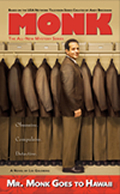
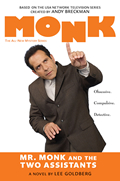
Yeah, Lee Goldberg, who obviously you know,
Teresa, you’ve interviewed him I believe
a couple times, who writes the Monk novels.
Lee had arranged a number of book signings
for his next Monk novel, which I believe
is Mr. Monk Goes to Hawaii.
MFP:
Right.
Terry:
Paula and I have known Lee for many, many
years. We coincidentally have worked together
from time to time for over 20 years.
Paula:
And he lives fairly close by to us too.
Terry:
Yeah, a total coincidence that he lives
pretty close by to us. So when he realized
that his book and our book were being released
on the same day, June 27th, he said, “Let’s
do some joint book signings.” So he
has arranged a number of book store signings.
He made the initial contacts with the bookstores
and then when they said yes, we confirmed
that we could do them on certain dates and
then NBC-Universal over there has apparently
come up with some giveaway items like some
postcards and things that they’ve
printed that they will be handing out to
make our signings a little bit more interesting
for anybody who comes and stands in line
and purchases the book for signature that
same date. We’re looking forward to
it. It sounds like it’s going to be
a lot of fun. We have four of them set up
in Southern California in the next sixty
days.
Paula:
Yeah, we’re lucky that Lee is such
a mover and shaker, because, you know, he
likes getting out there. I mean he’s
produced a number of T.V. shows and he’s
been freelance writing scripts for a lot
of them these days. He loves writing these
books too and he loves meeting the public
and autographing them so. We kind of feel
like he’s our agent in terms of setting
up these book signings: he says, “Come
on! Let’s go down there and sign!”
Terry:
Yeah, so we’re riding on his coat
tails.
MFP:
I don’t know where he gets the energy.
Terry:
He has so much energy. He’s a really
good guy and you know he’s written
a number of Monk episodes so we feel we’ve
already said thank you to him for setting
up the book signings by writing about him
in a couple places in the book, just because
we had to.
Paula:
But it was easy to get him lined up for
an interview at least.
MFP:
Well, that’s all the questions I have.
Terry:
Teresa, I want to tell you we really like
your site. You know the South Park character
thing is the first thing that I noticed
on your site. Lee actually told us about
your site a long time ago. And I turned
it on and just kind of dragged down through
it real fast until I came upon the South
Park characters. And I said wait a minute,
this is totally unique and different and
I clicked on that and it just grabbed my
interest so much that I went back to the
top and have gone through you site. We look
at the Monk Fun Page a lot.
MFP:
Thank you very much.
—The
End
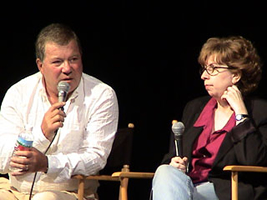
[I'll
review Monk: The Episode Guide
just as soon as I finish reading it. Below
are the only two pictures I could find of
the authors. Thanks to Abbye Simkowitz for
all her help.] |